Sunday, February 28, 2016

Cirque Traverse: attempt. Proposed First Winter Ascent of Wolf's Head

Zach passes the final tower on Wolf's Head, one of the wildest positions in the Wind River Range.
The most beautiful and oddly frustrating climbing I've done in winter. Taken from the summit. Background peaks in L-R order: Pingora, Mitchell, Wind River, Haystack, Steeple, Lost Temple Spire/East temple, Warbonnett, Temple, the Warriors.
"The nullifying, defeating,
negating, repeating
Joy Of Life."   -Joanna Newsom, Time, As A Symptom

The Cirque Traverse, again, this time in February with Zach Keskinen, a friend from CC, originally from Fairbanks, AK. We had previously climbed together in the Canadian Rockies, doing Curtain Call together, and in the Waddington Range, sending "The Wadd" and Combatant. He guides on Denali most summers, and I learned some things from his solid base of winter skills. He generally dealt with the cold better than I did, and his sense of humor kept morale high.

    Last year in January I skiied nearly 20 miles across the desert just to get to Big Sandy Trailhead, the normal summer starting point, with Niels Davis. We towed toy plastic sleds from harnesses, laden down with way too much gear, adding to the suffer quotient. Our friend dropped us off, and we traversed out the lander side to Sinks Canyon after climbing Pingora. 
     This time around Zach and I were able to borrow snowmobiles from Josh Wagner, a friend from Dubois, Wy. This helped us cross around 20 miles of snow-drifted sagebrush high-desert to get to within about three miles of the wilderness boundary, at which point the machines were stuck in bottomless powder. From there we skiied around 12 miles into the cirque where we slept in a wet snow cave and got-to-it on Pingora the next morning. The perfect, flaring, smooth granite of the cirque is poorly suited to double boots and crampons. Many of the cracks were full of snow and ice, and we would have an interesting challenge ahead of us. our heavy packs weighed us down but the psyche was high. Our sleeping bags were draped over our packs all morning to dry as we simul-climbed the sunny, southeast facing headwall.
Zach leading on pingora. We got off route trying the follow the East ledges (5.2) and ended up climbing some vertical handcracks (~5.7) and joining the upper South Buttress. In the future staying on the ledges would save time.


rapping off of Pingora and down to Tiger Tower.
Summitting Tiger Tower. Photo Zach Keskinen
Zach initially trying the sidewalk in boots and pons.
Zach, opting for a much harder but more protected and crampon friendly way around the sidewalk, (initially without crampons).
The East Ridge of Wolf's head was horrendously difficult. Without rock shoes the 4th and low 5th class sections of friction climbing became insecure and impractical. Anyone who's done this route in summer knows that it's a wonderful III 5.6, and part of the 50 crowded classics list. While the route finding is hard to nail (this fucked us hard, over and over again), the route is a casual outing in summer and gets soloed regularly.
Our pace was falling below that needed to conserve our food and fuel, and beat the violent close that our weather window would experience on Friday night. We climbed way too slowly.

When we hit the sidewalk I knew this would be an "attempt". This is sortof a hilarious place to start failing.

For anyone who hasn't been on Wolf's Head, the sidewalk is a blank 30 degree slab, directly on the knife edge, about 4 feet wide, with no protection for around 60 feet. It's difficult to even rate. In summer people routinely walk across it. Similar to Thank God Ledge on Half Dome, this is non-technical climbing requiring only balance, but with a twisted world of exposure (in one direction on Half Dome, but in both directions on Wolf's Head). With rock shoes this pitch is a cheese-cake scramble. Zach opted for a much harder way around it.

Whenever the wandering route ended up on the north side of the ridge, slabs up to 50 or 60 degrees were covered with a blanket of worthless sugar snow. Each hold needed to be excavated, by which time the footholds would be covered with snow as well. We were at the tail end of our first day, and I felt a lack of fitness and a massive lack of confidence mixed climbing on smooth granite creeping in. Any fall would end with a crunch on some ledge or slab.
For this level of difficulty, I can think of few routes less suited to winter techniques.
We got off-route in numerous spots, with the piton pitch being an especially bad spot.

Perhaps it's Kelly Cordes who said it's not the crux that'll shut you down, it's the unprotected snow on slab. The hard parts usually aren't hard.

The full sense of commitment kicked in. Falling and getting hurt would mean a 3-5 day self-rescue, and this (maybe justified) feeling showed through in our shitty leading. Sections we would have soloed in summer took hours as we pitched out slabby and wandery terrain covered with sugar snow, presenting no use-able footholds for our double boots and dulled out crampons. We were under-fueled and underhydrated, and we underestimated the magnitude of difficulty of every aspect of this adventure, from getting the car stuck, to getting the snowmachines stuck, to trying to keep our down bags dry, to the weight of our packs, and the impossibility of making good time on the ridge without soloing or simuling basically everything.

To our knowledge, Wolf's head has not been climbed in winter, and our newly adjusted goal would be to make it up and over Wolf's head, down the west face, and around to the Overhanging tower col, where we could safely bail back into the cirque. Rapping the S. face Beckey route was tempting, But we knew wet slides were ripping on the lower slabs, where we would find no anchors. This provided a good excuse to bail up and over the summit.

To complete the traverse we would have needed to climb Overhanging Tower (5.2), Sharks Nose (5.6), and Block tower (5.5), followed by a convoluted 2 miles of third class terrain over the Watchtower, the Warriors, and Warbonnet, then a descent back to our skis around the beautiful face with Black Elk.  We were done with the actual crux, but the alpine equivalent of the "redpoint" crux was still to come, maybe even somewhere after the "end of the technical difficulties" (as it always fucking seems to.)

While the climbing would have been easier ahead of us, and we may have been able to carry our momentum despite deteriorating form, the weather would not hold for us and we lacked the fuel to sit out a storm without running out of water.
I got cell service on the summit of Wolf's head and we made a few phone calls to our significant others. My dad gave me an updated weather forecast, 40mph gusts and snow the next day and night.
The Bail it is.

After we were set on bailing, it was easier to let go of the ego and just enjoy the views and the place, and the company of a friend. Our senses of humor greatly improved at that point.  Having a deadline to get out of the high country strangely seemed to lower the stress level for us.

Zach chimneying past tower 2
Day one draws to a close. our bivy on Wolf's head. We dug out the side of a hanging snowfield on the north side of the knife-edge. We slept tied in. Photo Zach Keskinen

crusty hands, trying to sleep in the cold at ~12,200.
Following the 4" foot traverse in double boots, with a 30lb pack. Got a crampon stuck partway through the 35 foot runout. (we didnt bring a #4.)uncomfortable to say the least. Zach enjoyed it more than I did. Photo Zach Keskinen
    I now have come to realize how stupid it is to try to do this cruiser, beautiful, fun ridge in calendar winter. It amounts to turning something great, which many people have done casually, into something difficult for a bunch of dumb and contrived reasons, and destroying a pair of crampons (at the very least) in the process. I'm not sure whether I enjoy the added challenge of climbing in winter or if I'm just vainly grasping at the novelty of the "winter ascent". Dates are just arbitrary numbers, but conditions are real. Someone could easily do this in an especially dry winter, or right around the equinoxes, maximizing the use of rock shoes and bare hands and minimizing weight in the pack, but I'm less interested in the distinction of "winter" than I am in the challenge of climbing in full conditions.
     That said, we both learned a lot about efficiency and technique when trad-mixed climbing in this type of moderate terrain. It was certainly strange to be so humbled by such a "classic trade route", but this didn't preclude the trip from being a good one.

I'll stop questioning this in time, and if the snow-pack settles and the weather calms next year I'm sure I'll try it again. I'm still obsessed. This year we had a great trip and made some progress.
Alpenglow on Bollinger peak (not a part of the traverse.)
If anyone knows about the winter history of the peaks here, drop me a comment. I've asked around  quite a bit and haven't found anything. Specifically most interested in whether wolf's head or pingora have had winter ascents, and if so via which routes?

Monday, February 1, 2016

Good Old Neon

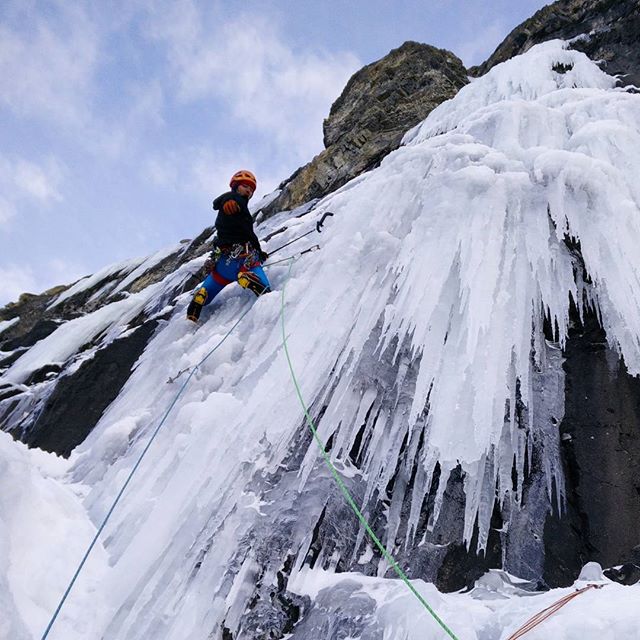
Ankle deep in the rest Hueco. Photo Sam Macke
   A little explanation of the name:

 Good Old Neon is a short story by David Foster Wallace. It explores the life of someone who has seemingly always felt in-genuine, a fraud, constructing their outside appearance and "putting on a show" in everything that they do. The subject and narrator is apparently dead and speaking from "outside of linear time".
   My brother recommended it to me, and a lot of this guy's insecurities and problems were disturbingly relate-able. The story was a shining example of how not to be, conveyed through DFWs self-indulgent but beautiful prose. This seemed like an appropriate name considering the following experience I had climbing the route.
   There were around 10 people at the crag, none of them climbing, all of them watching. When I ended up sending the thing, I had a peculiar feeling. When I was in the flow of the moves I was fully absorbed, but while I was at rests I wasn't sure if I was actually shaking out to combat the critical pump at this upside down heel-toe cam stance. Was I making faces because of the blood rushing to my head, or if I was just a pathetic actor performing for some kind of audience? I felt detatched from the experience of actually climbing, and it was disturbing to feel like such a "fucking show pony" as I later told a friend.

To keep it short, I hate climbing in front of people, primarily because my motivations become confusing and I lose touch with my self. This is the same reason that I can't participate in any kind of social media. This blog is the most overt form of public self-promotion I can engage in without hating myself and becoming confused about why I climb, and it still manages to have some of these effects. In sport climbing, it may not always matter why you climb. Sometimes sending, rather than having fun or experiencing self-discovery, is the only imperative, and people (myself included) manage to derive motivation from some dark, petty, or immature places. But if things get really dangerous or committing in other realms (far from sport climbing) it's important to be honest with oneself. A friend explained it like this:
   "I never tell anyone about the solos I do. I know that holds break and shit happens, and it's a waste of a life if you were trying to impress someone else. Your last thoughts are going to be "I don't want this to happen, it was all so stupid"".

I spent alot of time at the Bridge this winter, learning to bolt and training for specific routes and even specific moves. It was a rewarding experience to show up and send the longstanding project (Weasel Overdrive, M10/11), but it was much more satisfying to author my own routes, choosing lines and working fresh moves on natural, untouched features.  I added 10 bolts deeper in the cave, joining Weasel Overdrive right before the crux. This would be Good Old Neon. After bolting the line the day before, I gave it one beta burn and then sent second try, much to my surprise. I had no idea I was going to make links right away. Aaron Mulkey was onsighting a fun M8 that joins the big lines after the crux, and once it was apparent that I was sending he chose to hang tight and wait for me to complete the first ascent. This was a kind gesture, but now none of the 10 people at the crag were climbing, and the pressure was on. I went all the way to the second pair of chains, climbing fast and confidently up the ice to finish, and screaming at the end.
    This line was steeper, with many hard steinpull moves and spans near the limit of my reach. Again, I chose to climb in DTS, using no figures of four, as the euros say. This wasn't a detriment most of the time; the rock is beautifully featured and there are ample footholds even in the horizontal cruxes. Only on a couple of moves and one clip was I truly 'smearing' crampons on nothing. This is likely a spot where most modern mixed-wankers would opt for a figure four.

   I definitely lack the experience to properly rate this, not having redpointed many hard established mixed routes. The only thing it compares to are training routes in the Manitou Ghetto. I would say it requires a similar endurance effort to The Nihilist, but with the benefit of a relaxed and beautiful outro stemming between, and traversing across fragile ice daggers. There was one good rest utilizing a heel-toe cam in a hueco, but it was considerably worse (but less painful) than the knee-bar on Weasel Overdrive.

Good Old Neon, clipping in the crux, on the beta burn. Jade the dog at foreground. Photo Sam Macke
Another concern here: We haven't manufactured a single hold. The closest we've gotten is hammering in old picks to clear choss out of pockets and dirty seams. I think the natural features are really good, and I've always been opposed to  manufacturing, even in a wholly contrived discipline like dry-tooling. The only type of areas in which I've manufactured holds are ones in where the cliff itself is unnatural, like a quarry, or a blasted tunnel, like the Manitou Ghetto. While the early 20th century logging activity at the bridge left a permanent human mark in the rock, the tunnel itself is a natural, beautiful cave lined with calcite drip features, tufas, and stalactites. A lot of people have shared with me their ideas about manufacturing, and the modern, gymnastic potential the crag would hold if we "spanned" the blank sections with a bit of power-tooling. The bottom line is just that I don't want to be the one to do it. It leaves a bad feeling in the pit of my stomach. This is a wonder of nature and geology, not some fucking gods-gift to climbers that we can sculpt however we want. I don't care if "they all do it in europe".  As long as I'm working on this crag I don't want to see drilled pockets. I think it's complete bullshit. Using bad holds is a part of the challenge, and ice tools lend themselves well to this type of climbing. This will never be anyone's training crag in the way that the Ghetto, Vail Ampitheater, or the Hall of Justice are. For now there's no chance we'll run out of good, natural, unsent lines to bolt and climb.
Wrestling the moss blobs. photo Davis Merritt
Deeper in the cave, I spent three days aid-rope-soloing, taking as big of a whip as there's room for in the tunnel when a tool slowly seesawed out of a wet pocket. I was actually screwing a hanger on to a bolt when it happened. After several 5 hour sessions of bolting on lead, hanging out in the cold drips with a commercial fishing jacket and waders on, getting incredibly uncomfortable, I finally bolted the 60 foot roof.

The result is another project, Infinite Jest, and like the epic novel it'll take some serious time for me to finish. Moving along with the DFW theme, the hardest lines should naturally be named after the real monsters, The Pale King and Infinite Jest. The line is long and complicated, and at times contrived, and it's going to require some patience and commitment. I could have gone with physics related names, but instead the working name theme may be even more pretentious. It adds 50 feet of horizontal roof climbing into the crux sections of Good Old Neon and Weasel Overdrive. No matter the temperature, it's always dripping, and it's hard to work. One of the points of protection is a piece of 1-inch iron driven into the ceiling back in the days of the logging flume. It's going to go on all natural features, and it would represent a new level for mixed climbing in Wyoming. By the time I was done bolting the line, the season was drawing to a close, ice was falling down, and my body was telling me to take a break.
the incredible features on Infinite Jest.

 
another FA, Vermin Supreme, M8/9. (alot harder without the ice.)
So far my additions to the crag include:

Least Weasel M7                      (FA Niels Davis (funny business at the anchor...).)
Vermin Supreme M8/9              (first go with ice, sent dry Var. later.)
Weasel Overdrive: M10/11       (kneebar favors small legs, solid 11 if you can't get it.).
Good Old Neon.                        (way harder than Weasels)

Infinite Jest                                (tunnel project, unsent).
and two or three other unsent projects.

This season I managed to onsight every established mixed route at the crag, including
Superbowl Sunday, M8
Sam's M8 upstream, and
Whiskey Pneumonia M6/7

    So far no-one has confirmed Weasels or Neon. Phil managed a quick one-hang on Weasels and returned some positive feedback on the movement.  I've spent 15 or so days here this season, and every one has been memorable. The ice is all cooked for now, but I would be amped to have some people join me to help develop here next season. November and December are definitely the best times, and the only times when public access does not involve a 2 hr ski tour each way. Get in contact with me if you're interested. Right now there are serious access issues (on approach, not at the crag, which is on public land.), so understand that it may not happen. That's it for this year. Peace


Wednesday, January 6, 2016

First Ascent: Weasel Overdrive


1-5-16: Weasel Overdrive, First Ascent.

A huge thanks to Josh for discovering the crag and showing me around, and to Sam for equipping this beautiful route. And thanks to Mara for slogging the terrible approach over and over with me. I had to fight real hard and I'm proud that it came together.

The Stats:

4 or 5 redpoint attempts
12 miles of hiking and skiing on approach/deproach
2 redbulls consumed 
14 bolts + anchors
~45ft horizontal travel
3 broken holds
1 bleeding head wound
5 pairs of soaked pants
1 kneebar (2 if the ice is gone)
2 pairs of ripped pants
4 steinpulls(2 consecutively)
-zero figure fours/nines
-zero manufactured holds
ending with 15 feet of sweet, three-dimensional ice climbing

Forearm pump: very painful
This had great movement on positive, all-natural holds and more ice than your typical M-romp. I think it would be classic anywhere.  checks in around M11

Friday, December 25, 2015

Hyalite


Winter Dance, following P1

Made the onsight of Pitch 2 (M8) of Winter Dance


Phil on P3 of Winter Dance

Phil on Northwest Passage, M11 in the Bingo Cave
Skiing with Nick Merritt in Wy

Monday, November 30, 2015

French Reality

French Reality, Kurt leads Pitch 2.

I took a weeklong trip to the Rockies for Thanksgiving Break. Everything was, in one word: IN.

The Stanley Headwall, with Nightmare on Wolf Street and Suffer Machine visible.
French Reality, following pitch 2.

French Reality, Leading P3.


French Reality, Kurt leading P4.

Virtual Reality after soloing the approach steps.

Katie Bono on Virtual Reality


A sport day at the Bear Spirit Crag near Canmore


Tuesday, October 20, 2015

Some Rocks

Biting the curb, leading Death of a Cowboy, .13-, Indian Creek


Jack Schrott with the OS on one of Lander's Best, Brave Cowboy (12a)  at the Baldwin Creek Cliff
Jack Schrott on Spray, .13c, Elevenmile.

Fisher Hazen leads an airy crack on Big Bad Wolf (M5), Fairy Tale Wall, Pikes Peak.


Monday, June 1, 2015

All in: the 1984 French Route


    “At around 11p.m. on a day in late May we skied out of camp toward the beautiful and intimidating face. At the top of “ski hill,” J.D. mentioned, “I’m not nervous because I think we can’t do it, but because I think we can.” I agreed. We stashed our ski boots and planks at the base, then went into business mode.”   -Kurt
    The nerves came in a wave, numbing me out. This isn’t an accident. Nature has prepared an effective stress response over millions of years of trial and error. I was choosing to be here. I knew there was pain in my future. In the moment, when you’re up there in the flow of climbing, feelings are easy to subdue. But on flat snow, I looked up at 6,400 feet of vertical pain and uncertainty, imagining the infinite permutations of brutal futures and their bloody, beaten, and frozen outcomes. I felt tears form, and then flow as I knew for the first time what it really means to be safe, on flat ground. This was my point of decision, and the last time that fear would take hold.
    A week previously, Brett Baekey and I climbed Deprivation in 21 hrs. The crux comes early, and we ‘put it out there’ to make it go in difficult conditions. I lead at a crawl’s pace, taking great care, through thin seams and a section of gravity defying, unprotectable overhanging eggshell ice and Névé. I felt that I had exhausted one of my nine lives.
    The rest of the route flew by: we simul-climbed like never before, carrying the running belay through vertical ice and devious mixed cruxes. Climbing in this way is the ultimate expression of trust, and an unforgiving test of skill. We went to the “end of the technical difficulties”. We wanted to give it hell and slog to the top, but were locked in storm and pummeled by spindrift. The decision to bail was easy.
    24 rappels, core-shots, stuck ropes, and alternating confusion, despair, and bodily dysfunction saw us back to the ground. Clicking into our skis, we were too exhausted to actually make turns. We repeatedly slid, slumped, and crashed our way down three miles of glacier. We arrived back at camp having avoided sleep for 50 hours. We were hollowed out but thankful to have all our digits intact, pink, and warm. Brett developed a sickness and ran out of time in the range. He flew out to start guiding in Colorado. This was an ‘attempt’, but despite that painful fact, it was so far the greatest achievement in both of our lives.

Red: Deprivation('94) to bibler exit. Blue: the 1984 French Route. Cruxes circled. "bivy" marked.

    I wanted another go at Hunter, but via a harder route. I had no direction, and no plans for the summer. I felt no strong sense of future. I could stay in the range as long as my food would last. It was important to me to go to the summit. There are many ideas about what a “true-ascent” is, and I don’t really care to make any declarations on style; it’s personal. I stayed in the range and joined “Team Crevasseholes”, a young crew of Montana and Colorado climbers, equal parts bold and brash, in their well stocked base camp. We drank coffee and talked the talk all day as I recovered. Despite the big words, there was only one of these guys I would put it out there with.
    Kurt Ross, at 24, had already attempted the North Buttress twice. A Colorado Springs native, 6’3” and a fit 195, he could be seen wearing glasses at all times. His voice sometimes has a squeaky quality to it. He would lead serious pitches with care, but still set pace like an animal everywhere else. We met at a dry-tooling comp the previous winter, and the next day climbed traditional mixed routes on Pikes Peak. Our goals and hardline stances about tactics and style were similar. He wanted another go, and we agreed instantly that it would be via the French Route.
    Mark Westman calls it, “the proudest and most intimidating line on the wall.” It’s incredibly sustained, and the crux climbing comes at the end, keeping things uncertain throughout. Take Deprivation, replace all the snow ramps with steep, bullet-hard ice slabs, add a 7 pitch vertical headwall at the top, and replace the afternoon sun with the perpetual darkness of a true-north aspect, and you have the French Route.  Colin Haley describes the route: “First climbed in 1984 by two French alpinists, I personally think it is the classiest line on the North Buttress, first climbing the obvious couloir and then tackling the upper headwall that all the other routes avoid.” It didn’t see a second ascent until 2007. All my alpine climbing thus far had weaseled up weaknesses: This was a true line of strength. It was a leap of enormous hubris and naiveté, but we believed we could hold our own up there, and do it fast.
    We met some Slovenians in base camp, Luka Lindic and Ales Cesen. They looked young, maybe younger than us. Despite their youth, they have honed and tested their skills on the new-school steeps and applied them with success in the greater ranges. They wore faint smiles that clashed with the intensity of their stares. They gave us perfect beta in perfect English, describing crux after crux on steep ice, and blind, improbable route-finding around impasses. They were fresh off an attempt of the French Route, turned around by bad weather, and their memories were sharp.

some of the steeper climbing in the couloir

    We set out around 10pm at the beginning of the first reliable high-pressure, in a window of uncertain length. We climbed in single push style. It works well in Alaska, where the days are long and weather is chaotic. While it seems desperate to deprive yourself of rest and security, it increases the chances of success and minimizes exposure to get up and off a route quickly. It may be the safest way, and the mind altering experience it provides is unique.

    In our packs were no sleeping bags. We sharing one bivy sack to stick our feet in, and had a cut down piece of foam pad big enough for like 2.5 ass-cheeks. We strove to climb in “night naked” style, to use Voytek Kurtyka’s words. Our day-packs might have weighed nothing. I brought enough food to stay well fueled for about 24 hours, and marginally so for another 12, we knew the climb would take much longer than this. It wasn’t enough to feel good, but could be enough to make it. We brought enough fuel to melt 4 days of water. On approach we could see that the crux ice on Deprivation was already gone, just 8 days after Brett and I tiptoed over it.
    It was important to lead in blocks and made quick transitions for warmth and efficiency. We led and followed every pitch clean, “sending” not because we were trying to, but because we couldn’t waste time fucking around.


    Surreal and beautiful beyond description, we climbed through formations built by the full northern aspect and arctic weather. Kurt led around and through overhanging tentacles of ice in the upper North Couloir. One of my harness’ gear loops broke while leading a hard mixed pitch, and I managed to snatch the gear off it before it could fall into the abyss. Finishing the first third of the route quickly, we arrive at an impossible blade of snow, sticking straight out of an ice wall. It was protected from falling debris, but as exposed to the void as a diving board made of seafoam. We looked up at an endless and complex wave of blue bullet ice capped by zigzagging granite roof bands. We stomped out a place to sit and brew, studying a problem that looked impossible from below.
    Our light kit wasn’t warm enough to sleep at night: we were playing for all the marbles. At any given moment we needed to be either moving or bailing, and doing it quickly and deliberately. As a friend so gently put: “don’t fuck up an’ die”. This kind of system is a finely tuned machine with many moving parts. The failure of any one of these parts can lead to disaster without prompt action. This is ultimate vulnerability and fragility -- but also the pure freedom I have craved for as long as I can remember.

    I led a three pitch block, starting us up the headwall. There was no sign that it would actually go, but retreating from here was something beyond consideration. Because of all the traversing we had done over and around roofbands, retreat down from this point would be impossible. Instead we would have to traverse hard right and descent the Bibler Klewin, as a previous attempt at the second ascent did. The headwall is beautiful beyond description, and it was the reason we were there, so up we went. 7 pitches of sustained, steep, frozen blocks of laser cut granite made up the barrier at the end of the wall. It looked completely impossible from below, but somehow we kept finding stances and easy passages through roofbands, making slow progress.
One of countless sideways leads on this trip.
The first Zig-Zag
One of the best pitches, Kurt found a steep passage through the black band on cold, hard ice and quality granite.
The Second Zig Zag
Approaching the final headwall, where we found 7 pitches of steep mixed climbing.
Leading in the Headwall
another sunrise.

    It was night, again, and I was leading with a wet headlamp, corroding and dying. Thin, ancient ice covered bullet hard rock. The terrain dulled our picks and points into useless steel nubs. Kurt took over, thrutching up an overhanging off-width. The smell of sparks blew through the nostril burning freeze. I fell asleep at the belay, awoken by Kurt struggling against my short-roping. I took over again for the last pitch of the headwall. I was out of caffeine, but the fear of the upcoming lead woke me up again like a sharp slap. A short but fiercely technical pitch, the crux of the entire route, guarded the top of the buttress. We had come so far, but whether or not this pitch would go was our biggest unknown. I grew more awake with each move. I found a French angle piton welded and frozen into a vertical seam. This was the first sign in thousands of feet that we were on route. I clipped it for pro, and stemmed in the perfect 90 degree open book. I felt steel rest on single friable crystals jutting imperceptibly out of the wall--millimeters of contact, proprioception keeping the angle of my joints locked. My calves cramped but I remained steady. I took deep breaths, opened my mind to feel only the acute balance keeping me from pinballing backward over ice and rock, down past the belay, and taking a catastrophic whip on our 7.5mm ropes. At the 34 hour sleep-deprivation mark I found myself in a state of deep calm, even joy. Simple purpose took me through. I pulled the last tenuous moves, built a belay with two ice screws, and knew we put down the last of the hard stuff. I was thankful that the crux lead had been a test of my mind and balance, instead of my wasted and acidified muscles.  
    The Slovenians Luka and Ales stormed the route a week before us. At the top of the wall they were locked in storm and denied their summit push. They worked to dig snow and ice out from below a boulder to create a bivy. Based on their description, we were able to find it and we were thankful for the work they did. We slumped over on our packs at 12,600.

 Kurt:
    “I ogled J.D.’s extra pair of socks while he changed out of his wet ones. Endless pots of water and some man-spooning made us sharp again. We didn’t sleep for more than a power nap in length, but the short break was trans-formative.”

    This would be our only real rest. At this point I ate the last of my food and felt a renewed strength. We felt a unified will to summit.
    We went up, and the sun set in violent chemical hues.  We climbed over a corniced ridge employing a “Fairbanks belay”(this is actually an absence of belay; with both climbers giving full attention, if one person falls of one side of an unprotected ridge, the other climber jumps off the other side and hopes for the best.)

Above the headwall, and done with the crux of the route. The South Face of Denali Looms
The summit plateau, and the cloud that engulfed us.

    As the terrain opened up and we climbed into thinner air, the weather grew worse. It seemed to be over for us.  We stayed hunched down for a few minutes on flat, windblown terrain with sastrugi carved out of crust at 14,200 feet. Suddenly we could see less than a rope length; we seemed to be inside a cloud. We though it was over. As soon as it cleared we made a dash for the summit, reaching it in time for a perfect sunrise, looking over building clouds illuminated with fiery hues, and taking in an improbable view of Sultanta, Denali, and Huntington. We were faced with a difficult decision. Our high pressure window was imminently closing: in the last hour the clouds had gone from light and feathery to building and columnar in all directions. We were deeply satisfied to top out, but had to immediately decide between the supposed “simplicity” of a west ridge descent or the certainty of reversing our way down the upper Northeast ridge and rappeling back down the Moonflower.  We had never been on the west ridge, and getting royally lost in our state of exhaustion was all but mathematically certain if the visibility locked down again.


    We put it out there all the way up, so we gambled one more time: on a few more hours of visibility. Just enough to find the Ramen Couloir and get down. We descended quickly, with the weather closing in again as we left the upper mountain. We rappelled and down climbed into the western basin. Kurt hadn’t felt his toes or fingers in a while. I was in the depths of a full-bonk nutritionally and well deprived of sleep. I could smell the sick tones of decaying muscle in my breath. We quickly descended 8000 feet, finding warmer air.


The west face of Huntington at right


At the summit, haggard but happy


The South Face of Denali
From the Southwest basin, we trudged our way up, edging onto an exposed ramp to avoid an impassable icefall. Despite the fact that we made it safely up and over the mountain, back down there is where it got “the most real”.
    We found raps that would get us around the icefall. The first was off a stopper knot left years ago. I stepped over a blind edge, leaning back on our thin ropes, and inescapably sunk into a waterfall. The rope shuddered through my icy device. I stopped to pull the ropes out of a snare around a chockstone--all inside a vertical torrent. Icy water shot around a detached skeleton of an ice pillar. I kept my head down to keep breathing. It had to be done, we needed our ropes to continue, but now things became difficult. It was beginning to freeze at nightfall and snow was coming down. I was soaked to the bone.

    After I freed the ropes, I went off rappel and down-soloed through choss to a ledge and stripped naked, putting on the two articles of clothing that had been safe in my pack. I wore my down jacket on bare skin. There were no spare calories, in my pack or in my body, to shiver with. Without immediately stripping and wearing a down jacket on my bare skin, I would have become uselessly hypothermic and our choices would have been difficult. Kurt followed me down to the glacier, and we tied in for a broken maze. We trudged down to the main Kahiltna and around the sprawling massif. My only sustenance came from headphones.
Kurt:
    “The seven-mile zombie-slog that followed was an exceptionally weird experience. After over three days on the move, my grey matter was melting. Tribal drums and piano music played in the silence. I could see dozens of faces and figures in the features of the rock face next to us. Whenever I squinted toward the foot of a ridge in the distance, it would turn into a helicopter. We broke through the snow into crevasses numerous times.”

    We staggered back into camp during the first hours of Monday, June 1st, after a 75 hour push. We tallied 4 hours of sleep, plus maybe another hour accumulated from nodding off at belays, on rappel, or even on lead. When I think now about what it was like, it’s hard to breathe.
    From May 29th to 31st, Kurt Ross and I made the likely fifth ascent of the French Route, aka. Grison-Tedeschi, to the summit of Begguya, or Mount Hunter.  We believe the last full-ascent was by Colin Haley and the late Bjørn-Eivind Årtun, in 2009.
        I am a different person now.  Any part of me that wasn’t capable died as I fulfilled this dream. With time and distance, I have learned that I need this state of commitment, the sensitivity to intuition, and intensity of experience to really live. I’ll seek it out again.


The Southwest Basin in storm after our descent of the upper West ridge and Ramen couloir. Our timing was perfect, the high pressure was over just as we got back to low elevation.
May 13-June 6, 2015.

On this trip, I climbed:

Radio Control Tower,
w/Brett, Dave, Keenan, and Kurt

Mini-Moonflower, Left Couloir to N. Couloir, 85˚ice, 600m.
W/Brett Baekey

Micro-Moonflower, Bacon and Eggs, AI4, 500m.
w/Kurt Ross

Mount Frances, SW ridge, 5.8, 1250m.
w/Brett Baekey

Begguya, North Buttress, Deprivation. AK 6, 95˚ice(AI6 R), M6, 2000m.
    (to the top of the Bibler Come Again exit in 21 hrs) w/Brett.

Begguya, North Buttress, French Route. AK 6, 90˚ice, M6, 2000m.
    (to the summit, round trip in 75 hrs or 3d, 3h.) w/Kurt.


-I'd like to thank the Kellogg family and the Ritt Kellogg Memorial fund for making this trip possible.