Monday, June 1, 2015

All in: the 1984 French Route


    “At around 11p.m. on a day in late May we skied out of camp toward the beautiful and intimidating face. At the top of “ski hill,” J.D. mentioned, “I’m not nervous because I think we can’t do it, but because I think we can.” I agreed. We stashed our ski boots and planks at the base, then went into business mode.”   -Kurt
    The nerves came in a wave, numbing me out. This isn’t an accident. Nature has prepared an effective stress response over millions of years of trial and error. I was choosing to be here. I knew there was pain in my future. In the moment, when you’re up there in the flow of climbing, feelings are easy to subdue. But on flat snow, I looked up at 6,400 feet of vertical pain and uncertainty, imagining the infinite permutations of brutal futures and their bloody, beaten, and frozen outcomes. I felt tears form, and then flow as I knew for the first time what it really means to be safe, on flat ground. This was my point of decision, and the last time that fear would take hold.
    A week previously, Brett Baekey and I climbed Deprivation in 21 hrs. The crux comes early, and we ‘put it out there’ to make it go in difficult conditions. I lead at a crawl’s pace, taking great care, through thin seams and a section of gravity defying, unprotectable overhanging eggshell ice and Névé. I felt that I had exhausted one of my nine lives.
    The rest of the route flew by: we simul-climbed like never before, carrying the running belay through vertical ice and devious mixed cruxes. Climbing in this way is the ultimate expression of trust, and an unforgiving test of skill. We went to the “end of the technical difficulties”. We wanted to give it hell and slog to the top, but were locked in storm and pummeled by spindrift. The decision to bail was easy.
    24 rappels, core-shots, stuck ropes, and alternating confusion, despair, and bodily dysfunction saw us back to the ground. Clicking into our skis, we were too exhausted to actually make turns. We repeatedly slid, slumped, and crashed our way down three miles of glacier. We arrived back at camp having avoided sleep for 50 hours. We were hollowed out but thankful to have all our digits intact, pink, and warm. Brett developed a sickness and ran out of time in the range. He flew out to start guiding in Colorado. This was an ‘attempt’, but despite that painful fact, it was so far the greatest achievement in both of our lives.

Red: Deprivation('94) to bibler exit. Blue: the 1984 French Route. Cruxes circled. "bivy" marked.

    I wanted another go at Hunter, but via a harder route. I had no direction, and no plans for the summer. I felt no strong sense of future. I could stay in the range as long as my food would last. It was important to me to go to the summit. There are many ideas about what a “true-ascent” is, and I don’t really care to make any declarations on style; it’s personal. I stayed in the range and joined “Team Crevasseholes”, a young crew of Montana and Colorado climbers, equal parts bold and brash, in their well stocked base camp. We drank coffee and talked the talk all day as I recovered. Despite the big words, there was only one of these guys I would put it out there with.
    Kurt Ross, at 24, had already attempted the North Buttress twice. A Colorado Springs native, 6’3” and a fit 195, he could be seen wearing glasses at all times. His voice sometimes has a squeaky quality to it. He would lead serious pitches with care, but still set pace like an animal everywhere else. We met at a dry-tooling comp the previous winter, and the next day climbed traditional mixed routes on Pikes Peak. Our goals and hardline stances about tactics and style were similar. He wanted another go, and we agreed instantly that it would be via the French Route.
    Mark Westman calls it, “the proudest and most intimidating line on the wall.” It’s incredibly sustained, and the crux climbing comes at the end, keeping things uncertain throughout. Take Deprivation, replace all the snow ramps with steep, bullet-hard ice slabs, add a 7 pitch vertical headwall at the top, and replace the afternoon sun with the perpetual darkness of a true-north aspect, and you have the French Route.  Colin Haley describes the route: “First climbed in 1984 by two French alpinists, I personally think it is the classiest line on the North Buttress, first climbing the obvious couloir and then tackling the upper headwall that all the other routes avoid.” It didn’t see a second ascent until 2007. All my alpine climbing thus far had weaseled up weaknesses: This was a true line of strength. It was a leap of enormous hubris and naiveté, but we believed we could hold our own up there, and do it fast.
    We met some Slovenians in base camp, Luka Lindic and Ales Cesen. They looked young, maybe younger than us. Despite their youth, they have honed and tested their skills on the new-school steeps and applied them with success in the greater ranges. They wore faint smiles that clashed with the intensity of their stares. They gave us perfect beta in perfect English, describing crux after crux on steep ice, and blind, improbable route-finding around impasses. They were fresh off an attempt of the French Route, turned around by bad weather, and their memories were sharp.

some of the steeper climbing in the couloir

    We set out around 10pm at the beginning of the first reliable high-pressure, in a window of uncertain length. We climbed in single push style. It works well in Alaska, where the days are long and weather is chaotic. While it seems desperate to deprive yourself of rest and security, it increases the chances of success and minimizes exposure to get up and off a route quickly. It may be the safest way, and the mind altering experience it provides is unique.

    In our packs were no sleeping bags. We sharing one bivy sack to stick our feet in, and had a cut down piece of foam pad big enough for like 2.5 ass-cheeks. We strove to climb in “night naked” style, to use Voytek Kurtyka’s words. Our day-packs might have weighed nothing. I brought enough food to stay well fueled for about 24 hours, and marginally so for another 12, we knew the climb would take much longer than this. It wasn’t enough to feel good, but could be enough to make it. We brought enough fuel to melt 4 days of water. On approach we could see that the crux ice on Deprivation was already gone, just 8 days after Brett and I tiptoed over it.
    It was important to lead in blocks and made quick transitions for warmth and efficiency. We led and followed every pitch clean, “sending” not because we were trying to, but because we couldn’t waste time fucking around.


    Surreal and beautiful beyond description, we climbed through formations built by the full northern aspect and arctic weather. Kurt led around and through overhanging tentacles of ice in the upper North Couloir. One of my harness’ gear loops broke while leading a hard mixed pitch, and I managed to snatch the gear off it before it could fall into the abyss. Finishing the first third of the route quickly, we arrive at an impossible blade of snow, sticking straight out of an ice wall. It was protected from falling debris, but as exposed to the void as a diving board made of seafoam. We looked up at an endless and complex wave of blue bullet ice capped by zigzagging granite roof bands. We stomped out a place to sit and brew, studying a problem that looked impossible from below.
    Our light kit wasn’t warm enough to sleep at night: we were playing for all the marbles. At any given moment we needed to be either moving or bailing, and doing it quickly and deliberately. As a friend so gently put: “don’t fuck up an’ die”. This kind of system is a finely tuned machine with many moving parts. The failure of any one of these parts can lead to disaster without prompt action. This is ultimate vulnerability and fragility -- but also the pure freedom I have craved for as long as I can remember.

    I led a three pitch block, starting us up the headwall. There was no sign that it would actually go, but retreating from here was something beyond consideration. Because of all the traversing we had done over and around roofbands, retreat down from this point would be impossible. Instead we would have to traverse hard right and descent the Bibler Klewin, as a previous attempt at the second ascent did. The headwall is beautiful beyond description, and it was the reason we were there, so up we went. 7 pitches of sustained, steep, frozen blocks of laser cut granite made up the barrier at the end of the wall. It looked completely impossible from below, but somehow we kept finding stances and easy passages through roofbands, making slow progress.
One of countless sideways leads on this trip.
The first Zig-Zag
One of the best pitches, Kurt found a steep passage through the black band on cold, hard ice and quality granite.
The Second Zig Zag
Approaching the final headwall, where we found 7 pitches of steep mixed climbing.
Leading in the Headwall
another sunrise.

    It was night, again, and I was leading with a wet headlamp, corroding and dying. Thin, ancient ice covered bullet hard rock. The terrain dulled our picks and points into useless steel nubs. Kurt took over, thrutching up an overhanging off-width. The smell of sparks blew through the nostril burning freeze. I fell asleep at the belay, awoken by Kurt struggling against my short-roping. I took over again for the last pitch of the headwall. I was out of caffeine, but the fear of the upcoming lead woke me up again like a sharp slap. A short but fiercely technical pitch, the crux of the entire route, guarded the top of the buttress. We had come so far, but whether or not this pitch would go was our biggest unknown. I grew more awake with each move. I found a French angle piton welded and frozen into a vertical seam. This was the first sign in thousands of feet that we were on route. I clipped it for pro, and stemmed in the perfect 90 degree open book. I felt steel rest on single friable crystals jutting imperceptibly out of the wall--millimeters of contact, proprioception keeping the angle of my joints locked. My calves cramped but I remained steady. I took deep breaths, opened my mind to feel only the acute balance keeping me from pinballing backward over ice and rock, down past the belay, and taking a catastrophic whip on our 7.5mm ropes. At the 34 hour sleep-deprivation mark I found myself in a state of deep calm, even joy. Simple purpose took me through. I pulled the last tenuous moves, built a belay with two ice screws, and knew we put down the last of the hard stuff. I was thankful that the crux lead had been a test of my mind and balance, instead of my wasted and acidified muscles.  
    The Slovenians Luka and Ales stormed the route a week before us. At the top of the wall they were locked in storm and denied their summit push. They worked to dig snow and ice out from below a boulder to create a bivy. Based on their description, we were able to find it and we were thankful for the work they did. We slumped over on our packs at 12,600.

 Kurt:
    “I ogled J.D.’s extra pair of socks while he changed out of his wet ones. Endless pots of water and some man-spooning made us sharp again. We didn’t sleep for more than a power nap in length, but the short break was trans-formative.”

    This would be our only real rest. At this point I ate the last of my food and felt a renewed strength. We felt a unified will to summit.
    We went up, and the sun set in violent chemical hues.  We climbed over a corniced ridge employing a “Fairbanks belay”(this is actually an absence of belay; with both climbers giving full attention, if one person falls of one side of an unprotected ridge, the other climber jumps off the other side and hopes for the best.)

Above the headwall, and done with the crux of the route. The South Face of Denali Looms
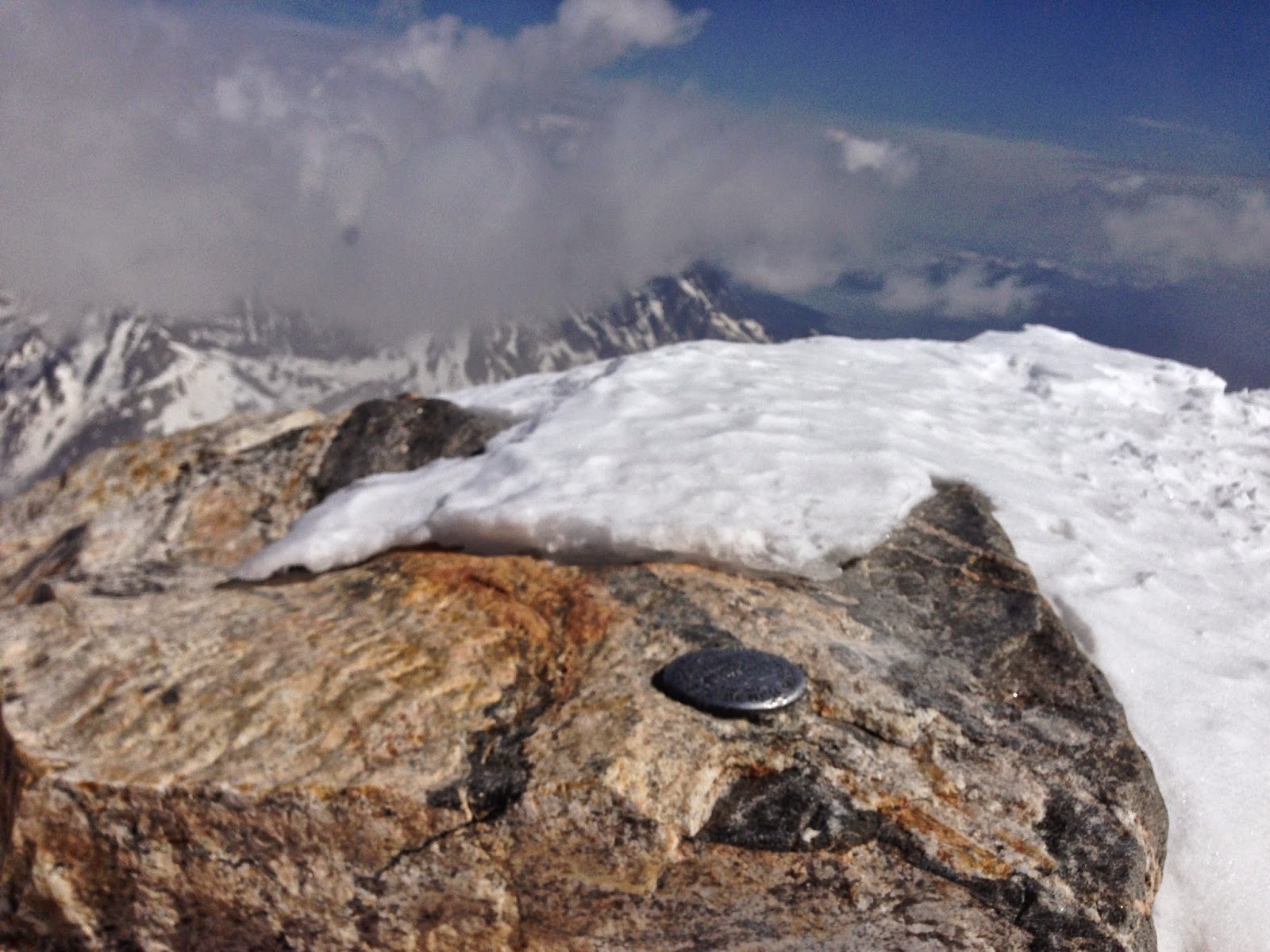
The summit plateau, and the cloud that engulfed us.

    As the terrain opened up and we climbed into thinner air, the weather grew worse. It seemed to be over for us.  We stayed hunched down for a few minutes on flat, windblown terrain with sastrugi carved out of crust at 14,200 feet. Suddenly we could see less than a rope length; we seemed to be inside a cloud. We though it was over. As soon as it cleared we made a dash for the summit, reaching it in time for a perfect sunrise, looking over building clouds illuminated with fiery hues, and taking in an improbable view of Sultanta, Denali, and Huntington. We were faced with a difficult decision. Our high pressure window was imminently closing: in the last hour the clouds had gone from light and feathery to building and columnar in all directions. We were deeply satisfied to top out, but had to immediately decide between the supposed “simplicity” of a west ridge descent or the certainty of reversing our way down the upper Northeast ridge and rappeling back down the Moonflower.  We had never been on the west ridge, and getting royally lost in our state of exhaustion was all but mathematically certain if the visibility locked down again.


    We put it out there all the way up, so we gambled one more time: on a few more hours of visibility. Just enough to find the Ramen Couloir and get down. We descended quickly, with the weather closing in again as we left the upper mountain. We rappelled and down climbed into the western basin. Kurt hadn’t felt his toes or fingers in a while. I was in the depths of a full-bonk nutritionally and well deprived of sleep. I could smell the sick tones of decaying muscle in my breath. We quickly descended 8000 feet, finding warmer air.


The west face of Huntington at right


At the summit, haggard but happy


The South Face of Denali
From the Southwest basin, we trudged our way up, edging onto an exposed ramp to avoid an impassable icefall. Despite the fact that we made it safely up and over the mountain, back down there is where it got “the most real”.
    We found raps that would get us around the icefall. The first was off a stopper knot left years ago. I stepped over a blind edge, leaning back on our thin ropes, and inescapably sunk into a waterfall. The rope shuddered through my icy device. I stopped to pull the ropes out of a snare around a chockstone--all inside a vertical torrent. Icy water shot around a detached skeleton of an ice pillar. I kept my head down to keep breathing. It had to be done, we needed our ropes to continue, but now things became difficult. It was beginning to freeze at nightfall and snow was coming down. I was soaked to the bone.

    After I freed the ropes, I went off rappel and down-soloed through choss to a ledge and stripped naked, putting on the two articles of clothing that had been safe in my pack. I wore my down jacket on bare skin. There were no spare calories, in my pack or in my body, to shiver with. Without immediately stripping and wearing a down jacket on my bare skin, I would have become uselessly hypothermic and our choices would have been difficult. Kurt followed me down to the glacier, and we tied in for a broken maze. We trudged down to the main Kahiltna and around the sprawling massif. My only sustenance came from headphones.
Kurt:
    “The seven-mile zombie-slog that followed was an exceptionally weird experience. After over three days on the move, my grey matter was melting. Tribal drums and piano music played in the silence. I could see dozens of faces and figures in the features of the rock face next to us. Whenever I squinted toward the foot of a ridge in the distance, it would turn into a helicopter. We broke through the snow into crevasses numerous times.”

    We staggered back into camp during the first hours of Monday, June 1st, after a 75 hour push. We tallied 4 hours of sleep, plus maybe another hour accumulated from nodding off at belays, on rappel, or even on lead. When I think now about what it was like, it’s hard to breathe.
    From May 29th to 31st, Kurt Ross and I made the likely fifth ascent of the French Route, aka. Grison-Tedeschi, to the summit of Begguya, or Mount Hunter.  We believe the last full-ascent was by Colin Haley and the late Bjørn-Eivind Årtun, in 2009.
        I am a different person now.  Any part of me that wasn’t capable died as I fulfilled this dream. With time and distance, I have learned that I need this state of commitment, the sensitivity to intuition, and intensity of experience to really live. I’ll seek it out again.


The Southwest Basin in storm after our descent of the upper West ridge and Ramen couloir. Our timing was perfect, the high pressure was over just as we got back to low elevation.
May 13-June 6, 2015.

On this trip, I climbed:

Radio Control Tower,
w/Brett, Dave, Keenan, and Kurt

Mini-Moonflower, Left Couloir to N. Couloir, 85˚ice, 600m.
W/Brett Baekey

Micro-Moonflower, Bacon and Eggs, AI4, 500m.
w/Kurt Ross

Mount Frances, SW ridge, 5.8, 1250m.
w/Brett Baekey

Begguya, North Buttress, Deprivation. AK 6, 95˚ice(AI6 R), M6, 2000m.
    (to the top of the Bibler Come Again exit in 21 hrs) w/Brett.

Begguya, North Buttress, French Route. AK 6, 90˚ice, M6, 2000m.
    (to the summit, round trip in 75 hrs or 3d, 3h.) w/Kurt.


-I'd like to thank the Kellogg family and the Ritt Kellogg Memorial fund for making this trip possible. 

Deprivation

The Moonflower
Enter guest writer Brett Baekey, aka. The Pump Bandit:

Kick, Kick, Swing

Just don’t look at it. It’ll be like it’s not even there. Besides, I’m not even the superstitious type, right? Right. So why am I so transfixed? Okay, just say a prayer. Wait, what the hell am I talking about, I don’t pray either. Calm down. That’s it. No not like that, definitely not like that. Look up, crane your worried head towards the sky, being sure to ignore the fact that most of the sky is currently blocked from view. Look at the route. Why did it even come up here anyway? This is in absolutely no way, shape, or form the proper place for a bird. How did it eat, sleep, shit (okay maybe that one’s not too much trouble, although when you factor in the eating issue…), procreate, enjoy, sing happy songs? It shouldn’t be here. This isn’t a place for the living. But I am here.

    The carcass of the finch or wren or whatever it once was lay quietly in the snow just a few hundred feet below the bergschrund.

     Oh how the stories always seem to go, running in their flaccid chronology from Beginning to Middle to End. Somehow this felt different, right from the middle on out. A chaos was fashioned by our frazzled heads into some kind of workable order; a plan born of a dream. The memories come fuzzy at first, even after just a few days as I sit here in the Spartan-like bunk in Talkeetna, lucidity more of an after-effect than an actual feature of the events. The buttress was huge. No, enormous. No, it was gargantuan, behemoth, grandiose while at the same time entirely understated. I couldn’t wrap my head around it, not at first, or second, or third. Possibly fourth. We spent our time in camp staring, and when we weren’t staring we were imagining. Hunter dominated.

    We had received a healthy dose of type 1, grade A fun on the southwest ridge of Mount Francis. Starting a climb in the dead of night (11:40 to be more or less precise) was a novelty and immediately enjoyable. The broken ridgeline went down in the first round, KO’ed so to speak. We surprised ourselves with how quickly we moved through the cruxes, all of them easier than advertised. Above the rock, a snowy arête led us to the false summit where we were forced to turn a cornice to gain the slopes leading to the true terminus of the mountain. This final bit of snow was rendered especially exciting for me after my crampons had taken a tumble down the mountain, somehow freeing themselves from the elastic confines of the bungee cord on the outside of my pack. Note: when your pack is not full, DO NOT, under any circumstances, lash your crampons to the outside of it. They will fall off. At the top we spun ourselves around in dizzying circles trying to take it all in. Denali, Foraker, and of course, Mount Hunter lay all around us in full 360. “The big three,” we had muttered. I chuckled inwardly at the ineffectualness of our chosen descriptor for said three.

    We had climbed Radio Control Tower first, several days before, in lovely weather. The idea behind doing this, we were to gather upon reaching the crest of that rather tiny knob, was to give the scale of the place a chance to sink in. We watched through binoculars as the “Bibler Come Again” exit at the top of the headwall was positively pummeled with spindrift.

    The North Couloir on the Mini Moonflower had taught me the importance of proper nutrition. For our first “real” climb in the range we awoke at 2:00am and downed 200mg of caffeine, first thing. I am a caffeine “noob”. I do not drink coffee, at least not enough to speak of, and when I do drink tea it is usually devoid of the stuff. After our first simul-block I felt empty headed and jittery, my stomach doing little pirouettes inside the hollow cavity of my gut as if to say, “Look what you did to us, you shithead.” Several pitches higher, the cramps started in. My limbs took on the appearance of worms left to dry in the sun, shriveled and useless, while my face twisted itself into an unrecognizable grimace. It was, in a word, unpleasant. These (the cramps) lasted the duration of the climb and the rappels. It must have been an amusing sight as I hunched over, completely unannounced, in surprising pain. I thank JD for not pointing and laughing. This hard-learned lesson was one I would need to retain, and I reminded myself of it incessantly.

DEPRIVATION:
Pronunciation:  /dɛprɪˈveɪʃən/
Etymology:  < medieval Latin dēprīvātiōn-em, noun of action from dēprīvāre to deprive v.
 1.
 a. The action of depriving or fact of being deprived; the taking away of anything enjoyed; dispossession, loss.

Enter dead, inspiring, frightening bird. Ambition was here, quite possibly too much. I wondered about our own fortitude. We had made (relatively) easy work of climbs that would not too long ago have been a very serious undertaking. It’s always difficult to say whether or not one is truly ready for a challenge that they know could very well be out of reach, just beyond the grasping. We approached in the fading light, trading words that seemed empty compared to what we felt inside. I told JD, “The person who lives in certainty never really lives,” and I tried to make those words my reality, embracing the expansive unknown that lay in wait. I felt both light and improbably burdened. We moved slowly on approach, sweating as little as possible to conserve precious water reserves. I remembered my Mini Moonflower schooling. No cramps, no cramps, please, oh please, no cramps. I pictured the height of the climb and then attempted to imagine how many of me that would equate to, height wise. Utterly useless. Better to just turn my brain off. Easier said than done. The surface of the glacier had stiffened with the setting sun, now crunching underfoot, and I hoped the crux would exhibit a similar response. I thought back to my childhood, the story of the little engine that could. I will be that engine, at least until I can’t. More crunching, or slipping, our skis making a zipping sound as we glided toward the hulking mass of granite, plastered (hopefully well enough) in snow and ice. To our left were our newly made friends, themselves off to attempt a north buttress route. We wished them luck in the form of ridiculous cheering and vigorous arm flailing, ski poles held aloft, and began our climb.

“You’ve got this man. You eat pitches like this for breakfast. You are the mixed master.” JD looked over to me appearing unconvinced.

Roughly 1,000 feet down we had crossed the bergschrund leaving our deceased friend behind. (Neither of us mentioned the bird to the other until afterwards.) JD had offered to lead on the first simul-block, taking us over 60 degree alpine ice with the occasional mixed move thrown in. A bit of near vertical powder kept things exciting and in short time I reached his belay. He handed the rack over and I started up the next pitch, intent on continuing to simul. “It doesn’t look so bad from here, kinda scary but I think we can both climb.” In the next ten feet I had drastically altered my position, both literally and otherwise. I yelled down to JD that, in fact, we would most definitely want to pitch this bit out. The rotten ice seemed barely attached to the wall, threatening to rip completely off with any serious swings or kicks. I muttered sweet nothings to myself and tiptoed up the runnel, placing mental pro in the mank. At the belay I unclenched my brain and swallowed heaps of air. JD followed quickly and after another easy pitch of actual ice we were at the crux.

Ping! “Good pro!” he yelled. I could feel the relief, albeit short-lived, that hit him. 30 feet of run-out, strenuous mixed ground saw JD kicking away bits of snice that guarded a seam in the back of a kinda/sorta compacted granite corner. I tucked myself further behind a cleft of rock and cowered, watching big chunks sail past. He stopped after each move to shake out, never letting the lactic acid build up, fighting away pump like a cornered animal. Two and a half hours had passed when I heard the call of “off belay”. It was now 5:30am. I sprinted from my sheltered stance, desperate to make up some time. Sprinted, that is, until I hit the brick wall of the crux, screeching to a halt at the start of the seam. It was maddeningly discontinuous, providing small openings with improbable stretches of blankness in between. I thought that maybe this section had been aided on the first ascent, Twight or Backes standing high in aiders and slamming in angles with half a body length separating them. I ripped out several useless pieces of protection and fought the pump myself, trying to climb quickly while still maintaining some semblance of control and poise. Several crystals exploded as I attempted to put some weight into my front points and I screamed. The two and a half hour lead now made quite a bit of sense. Pulling into the ice above, I gasped, having assumed that the difficulties would subside. While the climbing was physically easier here it was at least twice as dangerous. A bulge of overhanging mush guarded me from the belay. I sunk my tools to the hilt and lurched. I could hear my pulse ringing in my ears. Above me reared another 50 meters of the stuff. It was my lead.
Brett leading 75 degree neve during the short night.
following the crux pitch.

Above, Brett led another section of 95 degree Neve and ice.
“This is Lisa with the 8:00pm forecast. For 14k and below: a weak front will approach from the southwest bringing with it increasing winds and up to six inches of snow…” We had sat there in the tent listening, post dinner, concern over conditions replacing the sated feeling in our guts. But it was for naught. Each and every such forecast would be followed the next morning by bright sunshine and calm skies, making a fool of the weatherman and of us as we sat there in base camp twiddling our thumbs. We would learn not to place much faith in the forecast.

I left my mind as we left the first ice band and I became only legs and arms, swinging and kicking with the rhythm of the air. We churned skyward. Now roughly 1500 feet up, the first signs of fatigue had begun to set in. My breathing was deep but steady, not yet ragged and frayed around the edges as I was sure it would be later on. It was spectacular. This second rock band was a nice reprieve from the difficult climbing we had just dispatched, a chance to regain ourselves. We simuled once again, flowing over ice with interspersed mixed ground, the terrain virgin as of that point in the season. JD led and placed gear as sparingly as seemed prudent in an effort to make the block as long as possible. When he finally called to me that I was on belay we had climbed several hundred feet up the ramp. I followed to him and took what remained of our rack (very little) while he switched me over. Our transitions had become seamless and neither of us felt the need to say anything. The slab of ice seemed unending and I breathed a sigh of relief as I crested the final bulge and a thin neve arête came into view. I scampered to it, leaving a screw at it base. The screams of my calves subsided to a dull roar. Another 100 feet up and I had reached a cluster of rocks for the belay. Around the corner lay the second ice band; a chance to sit on the bench and suck down some much need nutrition. After a short while we had settled there. The stove hissed its approval of our quick progress and we gulped down water. New strength surged in us and we were further buoyed by a hot meal. JD pulled out the radio and made a call to our friends, who had long since turned around and gone back to base camp. We were given the forecast as we rested. “It looks like things will hold until sometime Saturday. It’s hard to say when, it could be sometime in the night or you could have good weather until tomorrow morning.” We looked at each other and then gazed towards the sky. Thin clouds streamed overhead while a substantial bank built itself in the far off distance. We had time. “I think we are going to try for the top of the Bibler exit and then start rapping,” JD replied. The radio crackled to life once more.

“Sounds like a prudent decision.”

I had left the ice screws. This bit of wasted time stung my pride and after bringing JD over to obtain them I felt obliged to make up the minutes. I searched for pro and found none; I searched some more. Finally, a hidden crack presented itself: a solid cam. I roared towards the final slabby chunk of the pitch. The ground was easy and I was on fire, or rather my ass was, the flame underneath it lit by both my previous mistake and our high position on the face. Now above the short crux of the third rock band, the sun gleamed off of the leftward angling snow ramp that would bring us to our finish. It was hot. It was too hot. The snow here was the consistency of mashed potatoes. Although it would be easy to climb in terms of technical difficulty, we both worried about the structural integrity of our medium. I needed to get us through this fast, I quickly realized. The thought of wet slides crossed my mind. I acknowledged it and then buried it. Worry would do us no good, now was a time for decisive action. “I’m gonna try to take us all the way to the third ice band!” I yelled to my partner. I looked at the gear left dangling on my harness. It’ll be a stretch.

“34 hours,” I had told him. “Although none of it was planned. I wonder if that makes it better or worse?” We discussed our previous longest pushes without sleep over a meal; less of a pissing contest and more a means of ascertaining just how long we could go this time. I thought back to those 34 hours. They had been soul-crushing, pushing me to my absolute physical and mental limit, and we hadn’t even been doing any technical climbing for at least half of it. I stole a furtive glance at the Buttress and wondered.

We turned the corner and stepped into a different world. The snow that had been deep, slushy wallowing on the third ramp was here a chalky powder improbably clinging to brittle ice. We slowed significantly, quite possibly the result of pushing just a bit too hard on the aforementioned ramp. What had earlier been mere wisps of water vapor began to coalesce into full blown clouds. Precipitation was still only a possibility, if an ever growing one. To the west, base camp barely registered, a series of insignificant blips in an expanse of white. The irony of our “remoteness” on this unceasing mountain face was not lost on me. Kick, kick, swing, kick, kick, swing, kick, kick, swing, swing, swing, swing, swing, swing (well fuck that) swing, kick, kick, etc. We crawled as the minutes raced. Upon reaching the belay it was decided that I would take the Bibler Come Again exit, hold the thrutching please. The offwidth crux loomed above and beyond my line of sight. I detested offwidths, these being the sorts of pitches that made my reptile brain squirm nearly as intensely as my body always seemed to while climbing the damn things. I began. Thin ice runnels snaked their way through nearly entombed granite blocks. In the back of my mind an awareness of our somewhat outrageous position as well as the building weather bank sounded quietly but continuously, like tinnitus that (I hoped) had not actually come to afflict me. The crux reared its head and we dueled. Lance and sword-less, I settled for terrifically mediocre offwidth technique and oh-shit strength. I had been informed that the crack adjacent to the offending one would provide excellent hand jams. I had been informed wrongly. My breath quickened as I realized that was supposed to be a hand crack was, in fact, a thin hand crack. I could only fit one knuckle into the maddening gash even with my thinnest pair of gloves. The offwidth assumed an air of friendliness, the ice tucked into it all but audibly inviting me to “climb here”. We topped the Bibler exit at 9:00pm, 21 and ½ hours after leaving the bergschrund. It had started to snow on top of the semi-constant spindrift. We made our decision.
A play by play account of the descent is, I’m sorry to say, out of the question; far too much bonking and all that. This being said:
Wind whipped snow down at us with zeal and we hurried our pace. We devised a system that we would end up repeating 20 or so times:
  1.  Designate someone (in this case JD) to spearhead the retreat. 
  2.  Person 1 (i.e. JD) rappels first, setting an ice screw anchor and a v-thread on arrival.
  3.  Person 2 (it should be obvious) goes on to rappel, removes the ice screw anchor from the soon-to-be-former engagement, and descends to Person 1.
    1. **editor's note: nod-off repeatedly on rappel and slump onto your autoblock.
  4.  Person 1 and 2 set to work on threading ropes, removing knots, pulling ropes, watching ropes fall, pulling ropes again but this time in a different direction, retying knots.
*Repeat as necessary until both participants are haggard and horizontal, the second of these hopefully by their own choosing.*

**Addendum: See Freedom of the Hills for the procedure employed when the ropes occasionally got stuck.


At the top of “the vision” we found ourselves the victims of unceasing and deafening spindrift. This victimization would become a theme of sorts. The creative parts of our brains were turned off and we became rappelling machines. A lack of food and water made this transition quasi-mandatory. We stopped after completing “the shaft” to take care of a few necessities. Snow was melted and bowels were moved. We felt much better. We moved into a dream world, each moment only loosely connected with the one before and after it. I felt like a zombie. Often I would be jolted awake by the call of “off rappel!” only to descend further and once again fall asleep on the anchor. With only two rappels to the bergschrund we found ourselves faced with a decision. JD rappelled straight down from the belay into a massive, blank rock scar. The word fuck rang through the hills. I put him on belay and he climbed back up to the anchor. I could no longer see any light in his eyes; my friend was a shell. We traded roles and I traversed across a ridge. Fixed tat! I rapped to it with what may have been hope growing in my heart. I could now see the bergschrund roughly one rope length below. JD joined me and I descended again. We were 20 feet short. I contemplated hucking myself across the five foot gap and then thought some more. Probably not wise, especially given your current skin-and-bones condition. JD managed to find some more tat to our left and he fed the ropes down to me. I fell directly into the maw, the ropes the only thing keeping me from being completely devoured. I clawed my way out and collapsed. Our skis, which we had left a day and a half ago, lay 500 feet down glacier. I managed to keel over with exhaustion five or six times in that distance. We reached our skis and shared half-hearted back slapping and congratulatory whooping. We were simply too tired to care much about anything other than sleep.
-
In the following days we regained our strength. My mind was still somewhere on the north buttress; day dreaming became my operative mode. We had climbed to the top of the wall, or at least the top of the technical difficulties. Our climb was, in essence, an attempt, a true ascent finding its terminus at the summit. This realization has not taken anything away from that day of climbing. As I boarded the plane to be taken back to Talkeetna I stole one last glance at the buttress. It gleamed brightly in the morning sun.


leaving our first brewstop.  heading for a short section of mixed climbing about 2500 feet up the wall, at the top of the 2nd iceband.


A beautiful hanging dagger above the ramp, futuristic. Is this the direct line that Edgar and Mills did in 2009?


Following the Bibler Come Again exit.  The last technical pitch, an ice-choked 5.9 offwidth.   


On rappel, after descending the Bibler-Klewin.  The iconic "prow" pitch. 

the Moonflower


I'd like to thank the Kellogg family and the Ritt Kellogg Memorial fund for making this trip possible. 


Wednesday, May 6, 2015

Grand Teton: Ski Descent, Solo


      Most people I've skiied or climbed with in the past years have somehow encountered my obsession with skiing the grand. I've worked hard to coerce partners, and even when I managed to convince someone I failed to make a descent for a number of reasons. Usually we've underestimated a big day on a complex mountain with unpredictable conditions. In spring, stability goes up and the travel gets easier. This May I decided to go it alone.

The view to Nez Perce, with the weather allready developing at 7:30am.
The day was off to a bad start.  With thunderstorms in the forecast, I decided to start at 3am.  I left Lupine Meadows with a pair of running-shoes on. Once these were soaked I eventually got out some dry socks and put the boots on.  The muddy trail gave way to an open slope of frozen spring snow, and as I skinned up the slope by headlamp I missed the cutoff into Garnet Canyon.  I didn't quite make it to treeline, but the transition to whitebark pine trees clued me into my mistake: I was way too high. I pulled my skins off and did some crusty, scraping, knee jarring pre-dawn turns, eventually finding some footprints in the snow that led me into Garnet.  All told I probably wasted about an hour and 600-800 vert. A warm-up lap, idiot style. This mistake made me a bit frustrated, and for the rest of the day my pace was a little bit too hard.
The start of the ice.
summit

The upper east face, with cloud moving in
   On the upper east face, I had a special moment.
The storms seemed imminent. For a few minutes the wind died and the clouds parted. I dropped in to perfect, mellow turns on a spreading ridge.  In every direction the slope dropped off blind.  It was like skiing on top of a breaking wave.  In terms of position, it's the best skiing I've ever done.
In the Ford, I found snow that was still frozen, and not really corned out and soft like the upper face.  The upper east face gets early morning sun, but the Ford receives sun later, maybe at 9.  Today the clouds had been in the way for much of that time. The ease of the upper face gave way to steeps: I would do one or two tight, controlled jump turns, hyperventilate for a few seconds, and then do it again.  It became slightly less fun as I got deeper into the gut of the Ford.
   I had climbed at too hard a pace earlier, and either due to that or the rolling fog, I was feeling dizzy. In climbing there is no cheating, only lying.  Full Disclosure: I didn't do a true ski descent(nor has anyone, as far as I know), because I did some rappels. But I decreased the purity of style further by down climbing the last part of the lower Ford to get to the first rap.  The snow wasn't soft or responsive, and I didn't feel psyched about making full consequence turns on crust. (the Ford is a hanging couloir, ie. death is assured if you fall and can't arrest).

The end of the snow rib on the upper face.  The ford couloir drops off to the right. North face of the Middle Teton in background.

The lower Ford.

I stashed the 60m of 5.5mm cord at the bottom of the Ford-couloir.
I brought: a harness, rap-device, cord, three nuts, one ice screw, a coathanger-abalkov threader, two tools, crampons.
I've climbed 5 different routes to the summit of the Grand now, and while this is certainly the easiest, it is one of the best days that I've ever had in the mountains.


On the last raps, the snow started coming down briefly.
The clouds rolled through chaotically during my descent, but the big storm held back until about 1pm.  By the time I ran out of snow and hit the trail, it was raining.  I backpacked my skis and hiked through mud. Back at the trailhead, the storm was at full tilt: I threw my skis in the car and jumped in to avoid the pounding rain.
I drove back to my parents house in Lander, where I slept hard.  I drove back to Colorado Springs Monday morning, missing my Partial Differential Equations class.

Back on the Teepee Glacier with the Kitty-cat skis.


The grand from the South Teton, 2012.  We were stormed out of the stettner.  The day before, talking to people on their way down,  we heard stories of powder on the upper east face.
After two other attempts over 4 years, I finally skied the grand. For a real ski-mountaineer, this isn't a difficult objective. For me, combining skiing and climbing techniques and getting the conditions right has been humbling, and I learned a lot in the process.

I hope this isn't the last time I ski the grand. I still hear legends of mid winter rime formations on the summit, and even murmurs of rare powder conditions on the upper east face.  In the future, I would like ski it with friends.  It has nothing to do with the sketch--I felt safe throughout my day.
Instead it's because I want to share a day like this with others.


Self-buttshot, North ridge of the Middle Teton, on a simul-solo with Erik. With featured but solid rock, the Tetons welcome steep scrambling.

Wednesday, April 15, 2015

King Cobra


     I have never posted at length about sport climbing, and never at all about sport-mixed or drytooling. This isn't because I don't do it.  For every pitch I climb in the mountains I probably climb 20 or 30 at a sportcrag. This is the first season that I put real work into mixed climbing, and to my surprise, on December 31 in Hyalite, I redpointed my first M10 second go.
On April 11, I redpointed my first M11, in Vail, once again on the second go.
     Maybe I haven't talked about sport climbing much because it is one of my prime weaknesses.  I have never had alot of physical power. From a young age I spent much of my time cycling and nordic-skiing, and eventually fell into a training regime that couldn't have been healthy for a kid. I developed a light frame and an aerobic engine.  What little muscle I had was all slow twitch.
     In practical terms, few things are more useless than huge dead-points and powerful inverts if you intend to take your climbing to long mountain routes. I sport climb because I enjoy the problem solving and getting pumped in a safe environment.  I have always loved limestone pocket climbing, especially in the savage Wild-Iris style.  This is probably because this style challenges me the most. The power-endurance style requires you to give it 100% the whole time. It's simple, as soon as you give it 95%: you fall. A series of finger injures in the autumn ground my rock-climbing to a halt; it was going to be a few months before I pulled on any pockets.  

I had a new idea.  It started in dingy basements and some abandoned train tunnels above Manitou Springs.  A dark 6 months of winter and what is basically just gymnastic aid climbing followed.


Brett Baekey Chucking a lap on Seattle Seven, G9+


We talked to each other about Nietzsche's superman on several occasions as we climbed these chossy routes with drilled pockets.  Brett on the send, Niall on belay.  I would send Seattle Seven seven times this season.


First, a little bit about the Ghetto...

Some of our climbing areas are pristine, some are even magical. Then there’s the Ghetto. 
    In my sophomore year of college I saw a photo on mountain project. Erik Welborn and Phil Wortmann were in the depths of a dark tunnel, clipping permadraws and throwing savage dry-tooling moves between pockets in a roof. It was hard to see where the route started or ended, but it was clear that it was all horizontal. I sought to find out where this was.
    Climbers love to ask questions about style, or ethics, or even questions that delineate the difference between the two. Yes, the ghetto is manufactured. Yes, we are drytooling, which may really just be enduro-aidclimbing. Yes, it is contrived. But any question you can ask about what we do in those dark tunnels goes out the window when we consider their origins: Dynamite. These abandoned rail tunnels go straight through the hillside, revealing 100 foot rooflines in broken pikes peak granite. Every hold, every inverted move, all the pro, and the crag itself is manufactured. I cannot thank Erik and Phil enough for turning the tunnels into the place we love to climb(if you can call drytooling that). They are the unsung heroes of C-Springs, and some of the best people around.

    After only a few weeks in October, the result of our training was that we, Brett, Jack, and all of the Ghetto crew, knew it was no longer possible to get pumped on the steepest ice.  This is fine.  Ice climbers NEED to get over themselves.  What we do is easy.  You have a jug the whole time.  Yes, an ice climb deserves respect and thoughtful movement, but no, it is no longer impressive in an athletic sense.  Ice is beautiful because it is a constantly changing medium, and it is enough that it is simply fun to climb, if no longer physically difficult.
    On ice tools, a minimal amount of training can have your 'pump-clock' following an asymptotic trend. When we weren't at the ghetto, we had training sessions in Phil's garage or Jack's basement. It's a huge mental asset to know that you can take your time on difficult traditional pitches, never becoming critically pumped.  But of course we had to take it further, trying to find our limits in the most ridiculous format-mixed climbing in huge, chossy caves.  Probably the dumbest part of this whole process was my development of an 'alter-ego'. One of my friends younger brothers, Caleb Wilson, once randomly gave me a soviet hockey jersey.  He didn't want it because it was whack looking.

I love most things Russian. The Brother's Karamazov, the legacy of Eastern Bloc Physics, Zamyatin's We, The Master and Margarita, Cold, Pain, Secularism, Alpinism, Cosmonauts, etc, etc.
    Naturally, I started wearing the hockey jersey all the time.  It was #10.  My friends started calling me Yuri.
 I was, "Yuri the Cosmonaut, with high probability mission failure".  I took it to Hyalite, to Ouray, to Vail, to Alberta. 

At the last stance on King Cobra. From here it's on

In mid winter, what most would call the legitimate mixed season, I spent alot of time pushing my onsight ability.  If I couldn't do something in two goes, it wasn't worth trying.  This strategy gave me good resting skills (this pissed off my climbing partners to no end), and good problem solving skills. I felt that I was developing precision.  Holds seemed to reveal themselves at the most desperate moments. I eventually onsighted 4 M8s, and made quick redpoints of several M9s and one M10.
   I probably over-trained, and after a few weeks of creaks and random pains my body was done mixed climbing. Eventually I lost the psyche as well and got pretty sick of it.  I shifted completely to aerobic training for a coming Alaska trip. At this point I was only running and ski touring.  Skiing is something that I've always enjoyed. I can't thank my parents enough for strapping skis on me as soon as I could walk. I think I like it more than climbing, at least in an immediate-joy-of-experience way.
Brett leading P1 of Nemesis, WI6.  Stanley Headwall.  

In february and march, I still climbed a bit, but mostly only in the alpine. I took a quick trip to the Canuckistan Rockies with Brett, where we climbed some classics like Nemesis and Asteroid Alley.


While I dont use spurs, I have taken to heel hooking as if I were wearing rock shoes.  The variety of movement on routes like this is huge.  The #10 soviet hockey jersey, complete with a hammer and sickle on the front, saw me to many invigorating sends.
For some reason I decided to go back to Vail in April, after I was 3 months deep into base training.  Jack and I met his friend Owen, a young whippersnapper of 18 with a great attitude and lots of mountain psyche.  Showing him around Vail and introducing him to mixed climbing was fun, and it helped me get over myself a bit.  I had been doing 15-25 hours of low level aerobic work each week, with only minimal focus on strength maintenence. I had no expectation that I could still do steep mixed climbs. With no pressure I decided to try King Cobra.  I held on through crux after crux, surprising myself as I guessed the right sequences and spotted tiny holds. The line gets progressively harder, with essentially no rests.  It's neighboring route, Red Bull and Vodka, has more inverts and harder cruxes, but also has many no-hands rests.  After the second clip on King Cobra, it was on.  I held on through the first anchor, sending to there onsight. I kept going, sending to the bail cord in the base of the roof, with the pump building.  I pulled into the inverts, guessing the right sequence, but desperately pumped. When I finally fell I was only two moves from the Fang.  I nearly onsighted my first M11. It's probably just M10, but the only stuff that makes less sense than grades are mixed grades...

The final invert, a figure-9 to gain the ice.
I lowered off next to a slushy fang with a waterfall raging inside.  Belay conditions were hardly ideal, and I had cramping arms contorted into stupid shapes.  We drove the awful 3 hour drive back to the Springs.
   I didn't change my training much, I was still mostly running, doing the incline with a weighted pack, and ski touring, but on two short 40 minute sessions each week, I went into Jack's dingy basement and did figure fours on a circuit of rings drilled into his ceiling studs. These sessions were at maximal intensity, and always to failure. I slipped off my tools trying to hook a tiny metal keyhole. I missed the pad, nailing my elbow on the dirty concrete floor six feet below.  Glad that nothing was broken, I got another lap in.
   Two weeks after my first go I returned to the Ampitheater with my brother, Nick, and Jack. Somehow the fang was still up. I feared for the life of my belayer, Jack, quivering at the base of King Cobra, grigri in hand. It was around 45 degrees and the fang was a mess--basically a multi-ton tower of slush with a deafening waterfall in the middle. It seems as if it had fractured, bent over a few feet, and then froze and re-healed all wonky.  I feel bad about this whole thing, because if the fang had fallen I might have been fine, just dangling on the end of a rope, clipped to a permadraw.  Without a doubt Jack would have been Fucked with a capital F.  I.e, if he were mangled, I'd be dangled, thanks to the grigri and fat rope. I instructed him to run away if anything big came down, even if he had to pull me off in the process.
    I gave it hell on my only try of the day, knowing I had the least dangerous job in the ampitheater...  Before the roof I tried to milk a shoddy rest stance, still over vertical, with terrible footholds.  After a few minutes I wasn't getting it back.  I was hesitating, and Jack knew it, yelling up to me to "make-moves".  I rattled off a few deep breaths and pulled into the series of inverts with a few candles left to burn. My mind turned off and a few blank seconds later I had my picks buried in the fang, was pumped as shit, and howling louder than the trucks on I70. I was glad to have a bolt at shoulder level as I kicked into the Fang. After all this, my reward(of sorts) was to climb 40 feet of slush-ice with no pro. I almost wanted to kick it down, but for Jack's sake I carefully topped out and untied. (stemming over an open streambed at the end).

Usually I am a neurotic goalsetter, but in this case a goal climb snuck up on me, and I gave it hell with no real expectations.  I'm done with sport mixed climbing for the season. Its time to rock climb.  If you've enjoyed this breast-beating ego-gratifying rant then either you're me or you're generous with your time.  Let me just say that mixed climbing should not be taken seriously by anyone, but it's been fun.

Wednesday, January 28, 2015

Pingora, Winter

All  Photos: Nielsen Davis


Guest writer Niels Davis, take it away.

Fun with Sleds:

Warbonnet

It seems each time I go to the Cirque of the Towers, I get the most exhausted that I’ve ever been. After a trip JD Merritt (’16) and I took this January, The Cirque has been cemented in my mind as a place where I continually discover new personal limits. Our plan was to drive as far as we could and ski the remainder to attempt the Cirque Traverse however, things did not go exactly as planned.
    One notable moment on the drive in was the sighting of a mountain lion bounding through the snow away from us after we came over a hill and surprised it. It was incredible to have the chance to see such a beautiful animal in motion. So much more graceful than us spending the afternoon repeatedly digging our car out of the snow and then getting stuck almost immediately afterwards. Eventually, we decided to abandon the heat and shelter and we turned to skis. Our friend Gus Griffin (’15) drove back to go ski with his cousin in Jackson and we skinned off into the dark with our equipment loaded into two kid’s sleds we picked up at the hardware store that morning. Concerning the sleds, some lessons need to be learned the hard way.


Getting stuck for the N-th time. This is where we started skiing.

by not making friends with any 'slednecks', I have gone and shot myself in the foot.  We skiied nearly 20 miles through flat desert on snowmobile tracks.  Yes, there is an easier way.

the end of another short, cold day

    The 12 miles we had estimated to the Cirque became 28 or so and after two-and-a-half days of skiing through the desert and woods we arrived in the Cirque slightly more tired than we expected. Despite the warm, sunny days, the nights were cold and our sleeping bags already wet so we opted for a snow cave. Due to the increasing winds signaling the closing of our weather window, and our physical condition we decided the Cirque Traverse was out of the picture. The next day we waited for the sun and set off for the South Buttress of Pingora. We reached the base around 10:30 a.m. and warmed our feet in the sun before switching to mountain boots and scrambling the initial portion of the climb. JD set off up the first pitch switching to rock shoes halfway through. He led the next two pitches in the rock shoes while I took photos and followed in mountain boots. The granite was warm enough in the sun and we were able to climb without gloves. The K-cracks held minimal ice due to the southerly aspect. I led the final snow gully up to the summit and belayed JD. This was the golden moment of the trip. The sun shone through and we fist pounded and looked out at the rest of the Wind River Range, particularly eyeing the snowy East Ridge of Wolf’s Head and the rest of the traverse that had evaded us this round.
Switching boots on the first real pitch.


Leading the left K-crack.

Following Niels' lead on the last pitch.

We rappelled as the sun set, leaving a few nuts and some cord on two instances when our rope fell short of the rap stations. The wind began to pick up and we were glad not to be on the ridge.
(editor's note: the storm got fucking heinous a couple of hours later, that night.)

 We hiked out the next day, taking the alternate 24 mile route back to Sink’s Canyon in Lander. As we admired the lesser-travelled Cirques to the east of the Cirque of the Towers, snow began to fall and visibility lessened causing us to skin over the wrong pass. We bushwhacked uphill while our sleds caught on each tree and bush for a few hours. As we gained the ridge, we realized that we had turned out of the canyon too early leading us to the wrong location. Nightfall came and we decided to call it a day. In the morning we realized that where we had expected a nice pass there was another cirque––a welcome sight in instances other than this one. That day we found the right pass and were determined to make it to Lander. For a long moment we travelled on a frozen creek, where JD lost a ski through the ice and had to get a little wet to retrieve it just an hour before sunset. We skied through the dark and eventually found the trail that would take us back to Lander. It was nice to let down our guard for a while and pound out a few miles, though we soon found ourselves rambling around in the woods as zombies after losing the trail. One of the sleds had broken in the front and began shoveling snow so we rigged it fishtail forward, which was a little more efficient. By the end of the trip it was only half of a sled, mostly held together by the cord used to lash our gear to it. We begrudgingly resigned ourselves to the tent and wet sleeping bags once more. The next morning we skied five or six more miles to the trailhead where JD’s brother met us. We drove back to his house, having completed an epic journey, and ate a lot of eggs and waffles. That night we drove back to Colorado Springs in order to make it back for school the next day. We kept ourselves awake with long, typical talks about relationships and the meaning of life, both almost exclusively illustrated with climbing analogies.


Wolf's Head

It had been textbook type-two-fun. As I sit here now amidst piles of books, the feeling in my sore legs brings me back to the final post-holed steps to the summit of Pingora and the storm clouds brewing over Warbonnet and Lizard Head. All in all we skied roughly sixty miles, managed to get a climb in, and received an incredible glimpse into the Wind River Range in winter. For now, we are satiated.


Summary:
Pingora, Winter Ascent, Cirque of the Towers, Wind River Range, WY.
South Buttress, K-Cracks 5.8

an untold amount of suffering while tied to sleds.