Wednesday, May 6, 2015

Grand Teton: Ski Descent, Solo


      Most people I've skiied or climbed with in the past years have somehow encountered my obsession with skiing the grand. I've worked hard to coerce partners, and even when I managed to convince someone I failed to make a descent for a number of reasons. Usually we've underestimated a big day on a complex mountain with unpredictable conditions. In spring, stability goes up and the travel gets easier. This May I decided to go it alone.

The view to Nez Perce, with the weather allready developing at 7:30am.
The day was off to a bad start.  With thunderstorms in the forecast, I decided to start at 3am.  I left Lupine Meadows with a pair of running-shoes on. Once these were soaked I eventually got out some dry socks and put the boots on.  The muddy trail gave way to an open slope of frozen spring snow, and as I skinned up the slope by headlamp I missed the cutoff into Garnet Canyon.  I didn't quite make it to treeline, but the transition to whitebark pine trees clued me into my mistake: I was way too high. I pulled my skins off and did some crusty, scraping, knee jarring pre-dawn turns, eventually finding some footprints in the snow that led me into Garnet.  All told I probably wasted about an hour and 600-800 vert. A warm-up lap, idiot style. This mistake made me a bit frustrated, and for the rest of the day my pace was a little bit too hard.
The start of the ice.
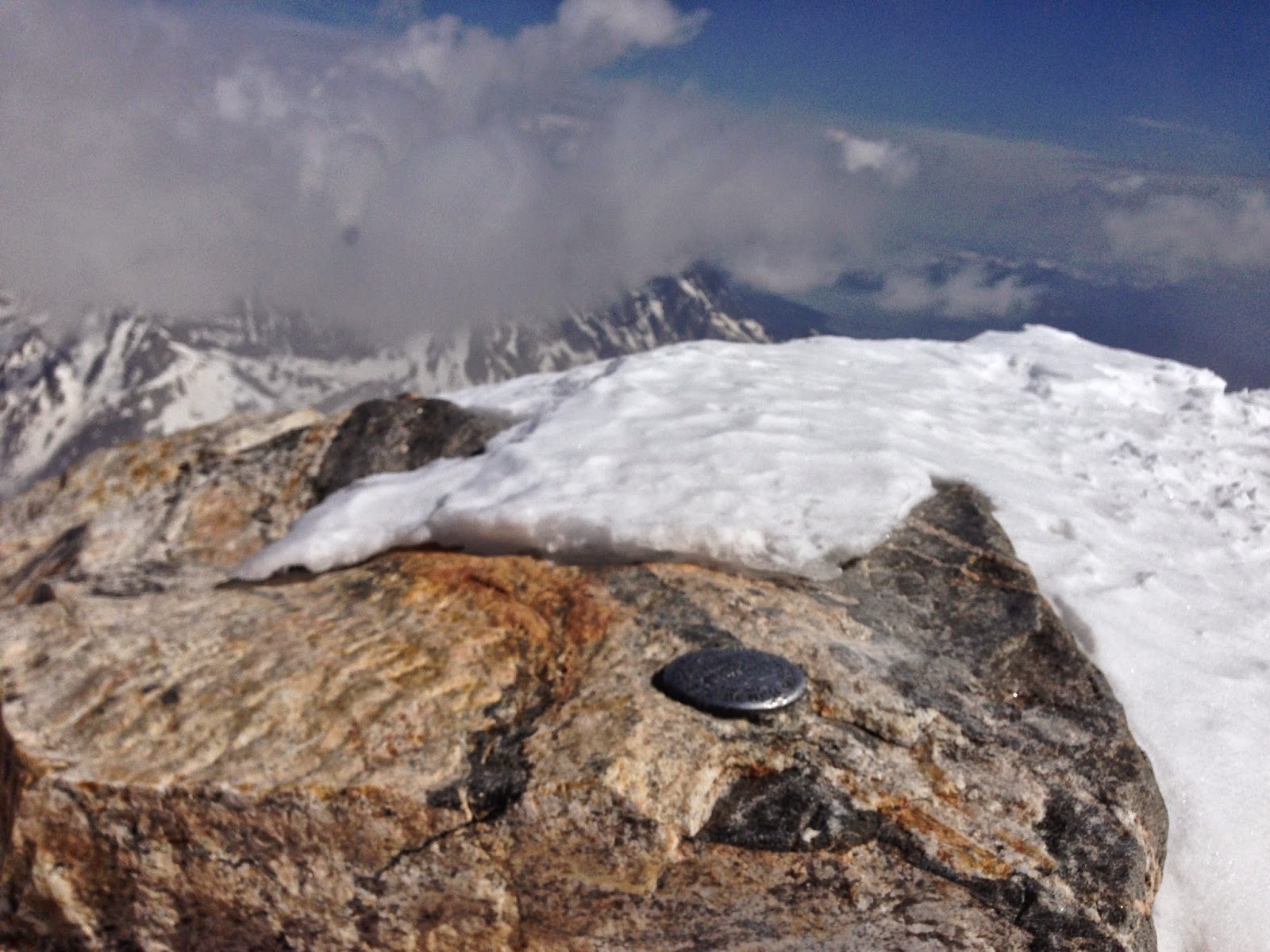
summit

The upper east face, with cloud moving in
   On the upper east face, I had a special moment.
The storms seemed imminent. For a few minutes the wind died and the clouds parted. I dropped in to perfect, mellow turns on a spreading ridge.  In every direction the slope dropped off blind.  It was like skiing on top of a breaking wave.  In terms of position, it's the best skiing I've ever done.
In the Ford, I found snow that was still frozen, and not really corned out and soft like the upper face.  The upper east face gets early morning sun, but the Ford receives sun later, maybe at 9.  Today the clouds had been in the way for much of that time. The ease of the upper face gave way to steeps: I would do one or two tight, controlled jump turns, hyperventilate for a few seconds, and then do it again.  It became slightly less fun as I got deeper into the gut of the Ford.
   I had climbed at too hard a pace earlier, and either due to that or the rolling fog, I was feeling dizzy. In climbing there is no cheating, only lying.  Full Disclosure: I didn't do a true ski descent(nor has anyone, as far as I know), because I did some rappels. But I decreased the purity of style further by down climbing the last part of the lower Ford to get to the first rap.  The snow wasn't soft or responsive, and I didn't feel psyched about making full consequence turns on crust. (the Ford is a hanging couloir, ie. death is assured if you fall and can't arrest).

The end of the snow rib on the upper face.  The ford couloir drops off to the right. North face of the Middle Teton in background.

The lower Ford.

I stashed the 60m of 5.5mm cord at the bottom of the Ford-couloir.
I brought: a harness, rap-device, cord, three nuts, one ice screw, a coathanger-abalkov threader, two tools, crampons.
I've climbed 5 different routes to the summit of the Grand now, and while this is certainly the easiest, it is one of the best days that I've ever had in the mountains.


On the last raps, the snow started coming down briefly.
The clouds rolled through chaotically during my descent, but the big storm held back until about 1pm.  By the time I ran out of snow and hit the trail, it was raining.  I backpacked my skis and hiked through mud. Back at the trailhead, the storm was at full tilt: I threw my skis in the car and jumped in to avoid the pounding rain.
I drove back to my parents house in Lander, where I slept hard.  I drove back to Colorado Springs Monday morning, missing my Partial Differential Equations class.

Back on the Teepee Glacier with the Kitty-cat skis.


The grand from the South Teton, 2012.  We were stormed out of the stettner.  The day before, talking to people on their way down,  we heard stories of powder on the upper east face.
After two other attempts over 4 years, I finally skied the grand. For a real ski-mountaineer, this isn't a difficult objective. For me, combining skiing and climbing techniques and getting the conditions right has been humbling, and I learned a lot in the process.

I hope this isn't the last time I ski the grand. I still hear legends of mid winter rime formations on the summit, and even murmurs of rare powder conditions on the upper east face.  In the future, I would like ski it with friends.  It has nothing to do with the sketch--I felt safe throughout my day.
Instead it's because I want to share a day like this with others.


Self-buttshot, North ridge of the Middle Teton, on a simul-solo with Erik. With featured but solid rock, the Tetons welcome steep scrambling.

Wednesday, April 15, 2015

King Cobra


     I have never posted at length about sport climbing, and never at all about sport-mixed or drytooling. This isn't because I don't do it.  For every pitch I climb in the mountains I probably climb 20 or 30 at a sportcrag. This is the first season that I put real work into mixed climbing, and to my surprise, on December 31 in Hyalite, I redpointed my first M10 second go.
On April 11, I redpointed my first M11, in Vail, once again on the second go.
     Maybe I haven't talked about sport climbing much because it is one of my prime weaknesses.  I have never had alot of physical power. From a young age I spent much of my time cycling and nordic-skiing, and eventually fell into a training regime that couldn't have been healthy for a kid. I developed a light frame and an aerobic engine.  What little muscle I had was all slow twitch.
     In practical terms, few things are more useless than huge dead-points and powerful inverts if you intend to take your climbing to long mountain routes. I sport climb because I enjoy the problem solving and getting pumped in a safe environment.  I have always loved limestone pocket climbing, especially in the savage Wild-Iris style.  This is probably because this style challenges me the most. The power-endurance style requires you to give it 100% the whole time. It's simple, as soon as you give it 95%: you fall. A series of finger injures in the autumn ground my rock-climbing to a halt; it was going to be a few months before I pulled on any pockets.  

I had a new idea.  It started in dingy basements and some abandoned train tunnels above Manitou Springs.  A dark 6 months of winter and what is basically just gymnastic aid climbing followed.


Brett Baekey Chucking a lap on Seattle Seven, G9+


We talked to each other about Nietzsche's superman on several occasions as we climbed these chossy routes with drilled pockets.  Brett on the send, Niall on belay.  I would send Seattle Seven seven times this season.


First, a little bit about the Ghetto...

Some of our climbing areas are pristine, some are even magical. Then there’s the Ghetto. 
    In my sophomore year of college I saw a photo on mountain project. Erik Welborn and Phil Wortmann were in the depths of a dark tunnel, clipping permadraws and throwing savage dry-tooling moves between pockets in a roof. It was hard to see where the route started or ended, but it was clear that it was all horizontal. I sought to find out where this was.
    Climbers love to ask questions about style, or ethics, or even questions that delineate the difference between the two. Yes, the ghetto is manufactured. Yes, we are drytooling, which may really just be enduro-aidclimbing. Yes, it is contrived. But any question you can ask about what we do in those dark tunnels goes out the window when we consider their origins: Dynamite. These abandoned rail tunnels go straight through the hillside, revealing 100 foot rooflines in broken pikes peak granite. Every hold, every inverted move, all the pro, and the crag itself is manufactured. I cannot thank Erik and Phil enough for turning the tunnels into the place we love to climb(if you can call drytooling that). They are the unsung heroes of C-Springs, and some of the best people around.

    After only a few weeks in October, the result of our training was that we, Brett, Jack, and all of the Ghetto crew, knew it was no longer possible to get pumped on the steepest ice.  This is fine.  Ice climbers NEED to get over themselves.  What we do is easy.  You have a jug the whole time.  Yes, an ice climb deserves respect and thoughtful movement, but no, it is no longer impressive in an athletic sense.  Ice is beautiful because it is a constantly changing medium, and it is enough that it is simply fun to climb, if no longer physically difficult.
    On ice tools, a minimal amount of training can have your 'pump-clock' following an asymptotic trend. When we weren't at the ghetto, we had training sessions in Phil's garage or Jack's basement. It's a huge mental asset to know that you can take your time on difficult traditional pitches, never becoming critically pumped.  But of course we had to take it further, trying to find our limits in the most ridiculous format-mixed climbing in huge, chossy caves.  Probably the dumbest part of this whole process was my development of an 'alter-ego'. One of my friends younger brothers, Caleb Wilson, once randomly gave me a soviet hockey jersey.  He didn't want it because it was whack looking.

I love most things Russian. The Brother's Karamazov, the legacy of Eastern Bloc Physics, Zamyatin's We, The Master and Margarita, Cold, Pain, Secularism, Alpinism, Cosmonauts, etc, etc.
    Naturally, I started wearing the hockey jersey all the time.  It was #10.  My friends started calling me Yuri.
 I was, "Yuri the Cosmonaut, with high probability mission failure".  I took it to Hyalite, to Ouray, to Vail, to Alberta. 

At the last stance on King Cobra. From here it's on

In mid winter, what most would call the legitimate mixed season, I spent alot of time pushing my onsight ability.  If I couldn't do something in two goes, it wasn't worth trying.  This strategy gave me good resting skills (this pissed off my climbing partners to no end), and good problem solving skills. I felt that I was developing precision.  Holds seemed to reveal themselves at the most desperate moments. I eventually onsighted 4 M8s, and made quick redpoints of several M9s and one M10.
   I probably over-trained, and after a few weeks of creaks and random pains my body was done mixed climbing. Eventually I lost the psyche as well and got pretty sick of it.  I shifted completely to aerobic training for a coming Alaska trip. At this point I was only running and ski touring.  Skiing is something that I've always enjoyed. I can't thank my parents enough for strapping skis on me as soon as I could walk. I think I like it more than climbing, at least in an immediate-joy-of-experience way.
Brett leading P1 of Nemesis, WI6.  Stanley Headwall.  

In february and march, I still climbed a bit, but mostly only in the alpine. I took a quick trip to the Canuckistan Rockies with Brett, where we climbed some classics like Nemesis and Asteroid Alley.


While I dont use spurs, I have taken to heel hooking as if I were wearing rock shoes.  The variety of movement on routes like this is huge.  The #10 soviet hockey jersey, complete with a hammer and sickle on the front, saw me to many invigorating sends.
For some reason I decided to go back to Vail in April, after I was 3 months deep into base training.  Jack and I met his friend Owen, a young whippersnapper of 18 with a great attitude and lots of mountain psyche.  Showing him around Vail and introducing him to mixed climbing was fun, and it helped me get over myself a bit.  I had been doing 15-25 hours of low level aerobic work each week, with only minimal focus on strength maintenence. I had no expectation that I could still do steep mixed climbs. With no pressure I decided to try King Cobra.  I held on through crux after crux, surprising myself as I guessed the right sequences and spotted tiny holds. The line gets progressively harder, with essentially no rests.  It's neighboring route, Red Bull and Vodka, has more inverts and harder cruxes, but also has many no-hands rests.  After the second clip on King Cobra, it was on.  I held on through the first anchor, sending to there onsight. I kept going, sending to the bail cord in the base of the roof, with the pump building.  I pulled into the inverts, guessing the right sequence, but desperately pumped. When I finally fell I was only two moves from the Fang.  I nearly onsighted my first M11. It's probably just M10, but the only stuff that makes less sense than grades are mixed grades...

The final invert, a figure-9 to gain the ice.
I lowered off next to a slushy fang with a waterfall raging inside.  Belay conditions were hardly ideal, and I had cramping arms contorted into stupid shapes.  We drove the awful 3 hour drive back to the Springs.
   I didn't change my training much, I was still mostly running, doing the incline with a weighted pack, and ski touring, but on two short 40 minute sessions each week, I went into Jack's dingy basement and did figure fours on a circuit of rings drilled into his ceiling studs. These sessions were at maximal intensity, and always to failure. I slipped off my tools trying to hook a tiny metal keyhole. I missed the pad, nailing my elbow on the dirty concrete floor six feet below.  Glad that nothing was broken, I got another lap in.
   Two weeks after my first go I returned to the Ampitheater with my brother, Nick, and Jack. Somehow the fang was still up. I feared for the life of my belayer, Jack, quivering at the base of King Cobra, grigri in hand. It was around 45 degrees and the fang was a mess--basically a multi-ton tower of slush with a deafening waterfall in the middle. It seems as if it had fractured, bent over a few feet, and then froze and re-healed all wonky.  I feel bad about this whole thing, because if the fang had fallen I might have been fine, just dangling on the end of a rope, clipped to a permadraw.  Without a doubt Jack would have been Fucked with a capital F.  I.e, if he were mangled, I'd be dangled, thanks to the grigri and fat rope. I instructed him to run away if anything big came down, even if he had to pull me off in the process.
    I gave it hell on my only try of the day, knowing I had the least dangerous job in the ampitheater...  Before the roof I tried to milk a shoddy rest stance, still over vertical, with terrible footholds.  After a few minutes I wasn't getting it back.  I was hesitating, and Jack knew it, yelling up to me to "make-moves".  I rattled off a few deep breaths and pulled into the series of inverts with a few candles left to burn. My mind turned off and a few blank seconds later I had my picks buried in the fang, was pumped as shit, and howling louder than the trucks on I70. I was glad to have a bolt at shoulder level as I kicked into the Fang. After all this, my reward(of sorts) was to climb 40 feet of slush-ice with no pro. I almost wanted to kick it down, but for Jack's sake I carefully topped out and untied. (stemming over an open streambed at the end).

Usually I am a neurotic goalsetter, but in this case a goal climb snuck up on me, and I gave it hell with no real expectations.  I'm done with sport mixed climbing for the season. Its time to rock climb.  If you've enjoyed this breast-beating ego-gratifying rant then either you're me or you're generous with your time.  Let me just say that mixed climbing should not be taken seriously by anyone, but it's been fun.

Wednesday, January 28, 2015

Pingora, Winter

All  Photos: Nielsen Davis


Guest writer Niels Davis, take it away.

Fun with Sleds:

Warbonnet

It seems each time I go to the Cirque of the Towers, I get the most exhausted that I’ve ever been. After a trip JD Merritt (’16) and I took this January, The Cirque has been cemented in my mind as a place where I continually discover new personal limits. Our plan was to drive as far as we could and ski the remainder to attempt the Cirque Traverse however, things did not go exactly as planned.
    One notable moment on the drive in was the sighting of a mountain lion bounding through the snow away from us after we came over a hill and surprised it. It was incredible to have the chance to see such a beautiful animal in motion. So much more graceful than us spending the afternoon repeatedly digging our car out of the snow and then getting stuck almost immediately afterwards. Eventually, we decided to abandon the heat and shelter and we turned to skis. Our friend Gus Griffin (’15) drove back to go ski with his cousin in Jackson and we skinned off into the dark with our equipment loaded into two kid’s sleds we picked up at the hardware store that morning. Concerning the sleds, some lessons need to be learned the hard way.


Getting stuck for the N-th time. This is where we started skiing.

by not making friends with any 'slednecks', I have gone and shot myself in the foot.  We skiied nearly 20 miles through flat desert on snowmobile tracks.  Yes, there is an easier way.

the end of another short, cold day

    The 12 miles we had estimated to the Cirque became 28 or so and after two-and-a-half days of skiing through the desert and woods we arrived in the Cirque slightly more tired than we expected. Despite the warm, sunny days, the nights were cold and our sleeping bags already wet so we opted for a snow cave. Due to the increasing winds signaling the closing of our weather window, and our physical condition we decided the Cirque Traverse was out of the picture. The next day we waited for the sun and set off for the South Buttress of Pingora. We reached the base around 10:30 a.m. and warmed our feet in the sun before switching to mountain boots and scrambling the initial portion of the climb. JD set off up the first pitch switching to rock shoes halfway through. He led the next two pitches in the rock shoes while I took photos and followed in mountain boots. The granite was warm enough in the sun and we were able to climb without gloves. The K-cracks held minimal ice due to the southerly aspect. I led the final snow gully up to the summit and belayed JD. This was the golden moment of the trip. The sun shone through and we fist pounded and looked out at the rest of the Wind River Range, particularly eyeing the snowy East Ridge of Wolf’s Head and the rest of the traverse that had evaded us this round.
Switching boots on the first real pitch.


Leading the left K-crack.

Following Niels' lead on the last pitch.

We rappelled as the sun set, leaving a few nuts and some cord on two instances when our rope fell short of the rap stations. The wind began to pick up and we were glad not to be on the ridge.
(editor's note: the storm got fucking heinous a couple of hours later, that night.)

 We hiked out the next day, taking the alternate 24 mile route back to Sink’s Canyon in Lander. As we admired the lesser-travelled Cirques to the east of the Cirque of the Towers, snow began to fall and visibility lessened causing us to skin over the wrong pass. We bushwhacked uphill while our sleds caught on each tree and bush for a few hours. As we gained the ridge, we realized that we had turned out of the canyon too early leading us to the wrong location. Nightfall came and we decided to call it a day. In the morning we realized that where we had expected a nice pass there was another cirque––a welcome sight in instances other than this one. That day we found the right pass and were determined to make it to Lander. For a long moment we travelled on a frozen creek, where JD lost a ski through the ice and had to get a little wet to retrieve it just an hour before sunset. We skied through the dark and eventually found the trail that would take us back to Lander. It was nice to let down our guard for a while and pound out a few miles, though we soon found ourselves rambling around in the woods as zombies after losing the trail. One of the sleds had broken in the front and began shoveling snow so we rigged it fishtail forward, which was a little more efficient. By the end of the trip it was only half of a sled, mostly held together by the cord used to lash our gear to it. We begrudgingly resigned ourselves to the tent and wet sleeping bags once more. The next morning we skied five or six more miles to the trailhead where JD’s brother met us. We drove back to his house, having completed an epic journey, and ate a lot of eggs and waffles. That night we drove back to Colorado Springs in order to make it back for school the next day. We kept ourselves awake with long, typical talks about relationships and the meaning of life, both almost exclusively illustrated with climbing analogies.


Wolf's Head

It had been textbook type-two-fun. As I sit here now amidst piles of books, the feeling in my sore legs brings me back to the final post-holed steps to the summit of Pingora and the storm clouds brewing over Warbonnet and Lizard Head. All in all we skied roughly sixty miles, managed to get a climb in, and received an incredible glimpse into the Wind River Range in winter. For now, we are satiated.


Summary:
Pingora, Winter Ascent, Cirque of the Towers, Wind River Range, WY.
South Buttress, K-Cracks 5.8

an untold amount of suffering while tied to sleds.

Friday, October 10, 2014

Stalker

photo: Erik Reiger
     What does it mean to be a Stalker?
     Obsession and purpose. Drawn by a calling, learning and relearning, one memorizes every rhythm and change, however small. It requires time and patience. At some point it becomes a compulsion and it is irrelevant to even ask why; one must return.
      In Andrei Tarkovski's 1979 film Stalker, a dark future has one last natural place, the Zone. No humans are here and supernatural laws rule. Those with the calling, Stalkers, have the ability to tap into it's subtle cues and signals, leading those who seek 'the room' at the heart of the zone.
     In the shots outside the Zone, decay and pollution occupy a grey on grey palate in the ultra-civilized world.  In contrast, the Zone is painted in vivid and surreal color. Nature rules and danger awaits those who stray from the Stalker's crooked path. The Zone is the only place where the Stalker's life has meaning.
     With many miles of hiking and reconnaissance over the months, Erik learned the rhythms of this mountain and knew it's potential. After several attempts this time would be the one. Conditions were perfect. He did the stalking and now he needed a partner.  In respect to the work he did, and to protect more lurking potential, I will simply say that this route is near (but not in) RMNP, and that it's on the west slope of the Front Range.

     I didn't have a lot of faith until he showed me this photo of rime coated rock.  This was taken the first week of October.  A storm brought moisture, and the route was in.  He made the 3.5 hour approach on Thursday with Phil Wortmann, one of Colorado's strongest winter climbers, who is fresh off a single push repeat of Deprivation on the North Buttress of Hunter.
    On Thursday they dealt with low visibility, cold, and high winds.  They decided not to start the route and post holed back the way they came only having laid eyes on the first pitch. 
    What did the route have to offer? Smears and streaks of ice appeared disconnected through the fog.  The crux looked steep, giving the imagination free reign.
    Given three more days, all that rime turned to ice.  On Sunday we made the approach, starting before dawn. Below treeline it was still fall with green grass and running streams.  Then we crossed a distinct boundary and entered a familiar place.


    Once again, he stood at the base of the route with visibility under a rope-length. Last time Erik and I started a rare and tenuous ice route, we skipped this step in haste, and I was injured (in a lucky outcome) as a result.  This was on the north face of the Grand Teton, in our attempt to repeat Shea's chute, a grade IV WI5 which was finally established solo in 1980 after three attempts. Anomalous storms this spring gave it some of the wildest ice I've seen, but conditions were unstable, and I could have paid dearly for my deafness to the obvious. I was struck with ice while leading and we began a slow and painful retreat.  My helmet was cracked completely through, and my knee swelled, making my kneecap invisible for a week.  
     A month later, we lost our friend Cole to an ice avalanche in the Cordillera Blanca.  The decisions I make seem to grow more complicated each year. There was a disturbing lack of discussion or affirmatives exchanged when we started the route in the Tetons that day.
   
  We paused and had a brief exchange on the apron of avalanche debris left from last winter. This time, our conversation was clear and to the point, thought for a moment we were both thinking back to that day on the grand. 

            "what do you think?"
            "not enough snow to avalanche, and there is definitely ice"
            "temps are good"
            "ice looks good"
            "fucking stoked"
            "pull the trigger."

the first pitch.

     With no hesitation, we rattled off pitch after pitch of perfect climbing, feeling good about every pitch, and every move.  This is the finest mixed climbing I've done in Colorado.  The line was direct and logical, and we could not have asked for better ice.  We had trust in each other and trust that the line would go. It unfolded seamlessly.

the first pitch, WI4 M4
 Erik led thin, vertical runnels on the first pitch.  The last of these gave a choice between two threads of ice, each only inches wide.  I led the pure-ice crux of our route on pitch 2, the smear of vertical ice in the first photo. It ended up being quite moderate which was in no way a letdown.  The climbing on soft, new ice was pure joy.
Sculpted by strong updrafts, ice roofs guarded passage on the third pitch.
on the other side of the cirque: lurking potential.

The middle section 'the narrows'
     The middle of the route was defined by lower angle ice in a wide bowl with short steps of vertical flow.  After the third pitch we simuled for at least 600 feet. The first 900 feet of the route were connected by perfect ice. The conditions we had may be rare, but little information exists for this area.  We know for sure that this route is only a safe proposition in fall, since the basins in the middle section of the route would present a serious avalanche hazard once the snow pack builds.
     Ice gave way to a steep mixed head-wall.  This is where we found the crux of our route.  First, a thin runnel of ice in a corner presented moderate climbing with limited protection.  Following this pitch, two pitches of steep and interesting mixed climbing on solid but compact rock had us placing peckers and knife blades for protection (all of which were cleaned).
Erik stands below the crux corner system.


Exiting one of the crux pitches.
 We topped out the unnamed peak to a view of a jagged skyline.  As we coiled the ropes, we saw a dragonfly, still alive in the snow.  We were thankful for a simple descent.
    The Stalker can't enter the room, there is nothing there for him.  The promise of the room exists for others, and it is said to grant your innermost wish. In the end, if you dare to enter, it only brings misery and pain. For some, this is the courtship with mountains.
    Our story played out differently. On this climb, every moment was enjoyable as the route revealed a natural, simple line to us. This day just served to reinforce my love for this pointless game.

We found no fixed gear on the route, and we also left none. Within the knowledge of the AAJ and the words of the area's most active climbers, Erik found no information about any routes on this face, so we feel comfortable calling it a new route.
Our routeline,
photographed in September before the ice reached full tilt.
Peak 12878', North side,
Stalker, FA, IV WI4 M5, 1100 feet.


Wednesday, October 8, 2014

Astrodog


The North Chasm View Wall from Astrodog.
Told mostly in photos, here is the story of Astrodog, one of Colorado's sweetest long free routes.  Luke Rasmussen, Brett Baekey, and I went to the south rim of the Black Canyon of the Gunnison for the first time, and before dawn we began our first rappel. 
The first of 11 double rope rappels.

The sun rose a couple of raps in.  Yes, those are down booties.


once it got warm, Luke revealed his Pizza Slut shirt.  Mid length sleeves provide adequate offwidth protection,
while an exposed midriff is both dashing and well ventilated.  We believe this is the future.


A perfect corner just above the 2-boulder bivy.


Pitch 8, Brett leading a 5.11 corner.


Pitch 10: Luke leads the thin corner just before the crux.


We were pretty worked.  The route took us about 11 hrs from bottom to top.  No-one ended up sending the crux, a blank stemming book where the 'good' piece is a 000 C3.  Later, we decided to get worked in a venue which, while still plenty difficult, is a polar opposite to the Black.

O-Town on Simply Read in Rifle.